
Westminster Wood Flooring installs wide plank hardwood flooring in Westminster, CA, serving surrounding cities including Midway City, Garden Grove, Stanton, Fountain Valley and Huntington Beach. We also lay herringbone and chevron patterns, which share the same demands as wide boards: a flat, dry subfloor, a precise layout and a product built to stay stable. Over 20+ years of installations, those three things have decided whether a statement floor stays beautiful or starts to gap and lift.
Wide boards and patterns show more of the wood and more of the workmanship. Every seam, every layout line and every bit of movement is easier to see, so we test moisture, flatten the subfloor and plan the layout on paper before a board is cut, and the estimate shows material, preparation and pattern labor as separate lines.
Wide Plank Hardwood Floors
Why Wide Boards Move More
Wood expands and shrinks across its width as humidity changes, and a wide board has more width to move. A seven- or eight-inch solid board can open a noticeable gap in dry months and cup if moisture rises from below. That movement is why moisture content at installation matters so much on wide floors, and why we measure the boards and the subfloor with a moisture meter and install only when the readings sit within the manufacturer’s range.
Engineered Wide Plank for Stability
Engineered wide plank puts a real hardwood wear layer over a cross-laid core that resists movement, which makes wide boards practical over concrete and in homes where indoor humidity swings. The wear layer thickness decides how many times it can be sanded later, so we show that specification alongside the price. For many homes, engineered is the only wide plank option that makes sense on a slab.
Species and Grade in Wide Widths
White oak is the most common wide plank species because its grain and tone hold up well across a broad face and take stain evenly. Hickory brings strong color variation and high Janka hardness, while walnut offers deep brown tones on a softer wood. Character grades with knots and mineral streaks tend to look natural in wide widths, and clear grades give a calmer, more uniform floor.
Wide Plank in Condos and Upstairs Units
A wide plank floor upstairs or in a condo sits over someone else’s ceiling, and many associations set a minimum sound rating for the underlayment, often written as a delta IIC rating. Some also require board approval of the product and limit the hours when installation can happen. We read the association’s alteration rules first, choose an acoustic underlayment that meets them and match the installation method to it, since a floating wide plank floor and a glued one call for different underlayments.
Herringbone and Chevron Patterns
Herringbone Layout
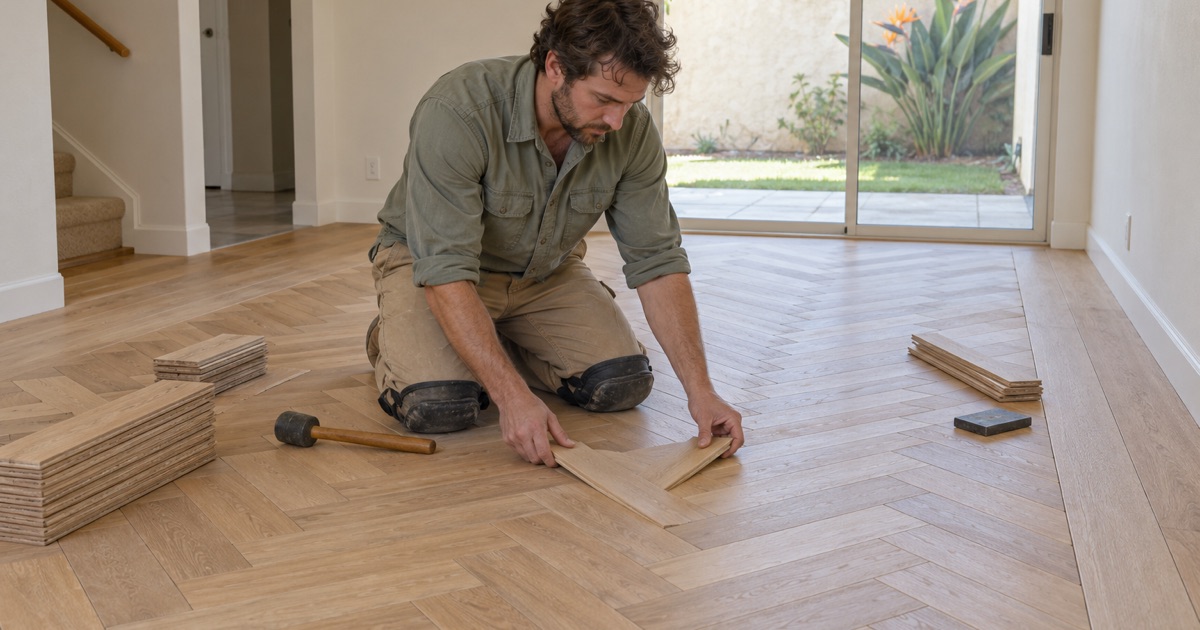
Herringbone is laid in short rectangular pieces set at right angles, so each board’s end meets the side of its neighbor in a zigzag. The pattern starts from a centered layout line snapped down the main axis of the room, and every row is checked against it, because a small error at the start grows across the floor. Borders around the edge of a room can frame the pattern and simplify the cuts at the walls.
Chevron Layout
Chevron pieces are cut at an angle on each end, so they meet in a clean point and form a continuous V down the room. The angled ends leave no room for error in the layout; each piece has to be placed precisely to keep the points aligned. Chevron flooring usually comes as a matched left-and-right product, and we order enough to cover the extra waste at the edges.
Flat Subfloors and Pattern Floors
Pattern floors made of short pieces show every ridge and dip beneath them, because each piece follows the surface independently. We flatten wood subfloors by sanding high seams and shimming low areas, and on concrete we grind high spots and fill low ones before checking with a long straightedge. Engineered herringbone is typically glued down, which also helps the short pieces stay tight.
Borders and Transitions Around a Pattern
A herringbone or chevron field has to stop somewhere, and how it stops decides whether the floor looks finished. A border of straight boards around the room or at a doorway gives the pattern a clean frame and hides the angled cuts at the walls. Where the pattern meets tile, carpet or a straight-laid floor in the next room, we fit a flush threshold, reducer strip or T-molding cut to the pattern’s line, so the change reads as deliberate rather than as the place the layout ran out.
Installing Over Wood and Concrete Subfloors
Testing the Slab Before a Wide or Pattern Floor
On a concrete slab, moisture rising from below is the main threat to both wide boards and patterns. We test with the ASTM F2170 in-situ relative humidity method or a calcium chloride test, write the readings down and compare them with the flooring manufacturer’s limit. A slab that reads high calls for a vapor retarder or a moisture-control adhesive before anything is glued down.
Nail-Down, Glue-Down and Fastening Wide Boards
Solid wide plank over plywood is fastened with cleat nails or staples through the tongue, often combined with adhesive to hold the wide face flat, following NWFA installation guidelines. Engineered wide plank and most herringbone on concrete are glued down with the adhesive and trowel the manufacturer specifies. The expansion gap at every wall is kept consistent and covered with baseboard or shoe molding.
Finishing and Living With Statement Floors
Stain, Finish and Sheen on Wide Boards
Wide plank floors often look best in natural or lightly toned finishes that let the grain show across the broad face. Unfinished boards can be site-finished with stains and finishes that meet the South Coast basin’s 275 g/L wood-coating limit, while prefinished boards arrive with a factory-cured coating. Matte and satin sheens hide daily wear best on large, open floors.
Keeping Seasonal Gaps Small
The best protection for a wide or patterned floor after installation is steady indoor humidity. Running air conditioning in summer and avoiding very dry heat in winter keeps boards close to the moisture content they were installed at. Felt pads under furniture, prompt cleanup of spills and a damp, not wet, mop keep the finish and the joints in good shape for years.
- 20+ Years of Floor Work
- Written, Itemized Estimates
- Moisture Readings Recorded