Westminster Wood Flooring has handled wood-flooring in Santa Ana for more than 20 years, often in houses where the floor is older than anyone living on it. We repair, refinish and replace hardwood, and in the older neighborhoods most of that work starts with a question about what is already there and whether it can be saved. Our first visit is spent measuring and looking, not selling a square-foot number.
Before any material is ordered, we read moisture in the boards with a wood moisture meter and, where the floor sits on concrete, in the concrete as well, and we write every reading down. We also walk the subfloor before we price a finish floor, because a soft spot or swollen sheathing found on day one costs far less than one found after the new boards are down. The written estimate that follows is itemized line by line, so you can see what each part of the job costs.
Much of what we do here is careful, small-scale work: patching in a few boards, sanding a floor that has not been touched in decades, or matching a discontinued plank so the repair does not show. The sections below explain how that plays out in the city’s historic houses and in the newer housing around them.
Floral Park Joins the National Register
In February 2023, Floral Park was added to the National Register of Historic Places, becoming Santa Ana’s third National Register district after Downtown Santa Ana (1984) and French Park (1999). The district sits in the north-central part of the city, about a mile north of downtown, roughly bounded by Santiago Creek, 17th Street, Broadway and Flower Street. The Floral Park Neighborhood Association describes it as the largest such district in Santa Ana. Its history page places the neighborhood’s start in the early 1920s, soon after World War I.
What the Registration Form Counts
The nomination counts 673 total resources, of which 576 are district contributors and 97 are non-contributors, mostly because of lost integrity or construction after the period of significance. It also notes that over 199 of the residences were already on the Santa Ana Register of Historical Properties before the national listing. Other sources count the homes differently, so we treat these figures as the nomination’s own rather than a settled total.
Period Revival, Mostly One Story
The form describes the residences as primarily single-story, single-family dwellings in Period Revival styles, from Tudor Revival and Mission or Spanish Revival to Storybook and Chateauesque. Builders it names include Frank Lansdown, W.H. Dixon, Roy Russell Sr, Jasper and Wesley Farney and Allison Honer. Most of the subdivision’s construction was complete by about 1939, which is why the nomination calls its concrete-paved streets appropriate to the era.
The nomination also says the vast majority of these pre-war buildings are very well maintained and have seen very minimal to no alterations. The changes it lists as costing a house its contributor status are all exterior: resized window openings, facade additions, drastic porch changes, and combinations of replacement windows, doors, roofing and cladding. Nothing in the pages we have read addresses interiors or floors, and we do not suggest otherwise to a homeowner.
For an owner, the practical point is that these are houses people have chosen to keep close to how they were built. That shapes how we approach the floors inside them, and it is why the next two sections lean toward saving wood rather than replacing it.
Looking for wood-flooring closer to Hawaiian Gardens? See Wood-Flooring Services in Hawaiian Gardens.
Floors Inside a One-Story Period Revival House
A floor in a house finished around 1939 has likely lived under more than one covering and through more than one owner. We do not assume a species or a build-up before we look; we lift a vent cover or a threshold, check the boards, and measure the moisture content before anything is decided. What we find sets the plan, not a catalog.
Under the Carpet
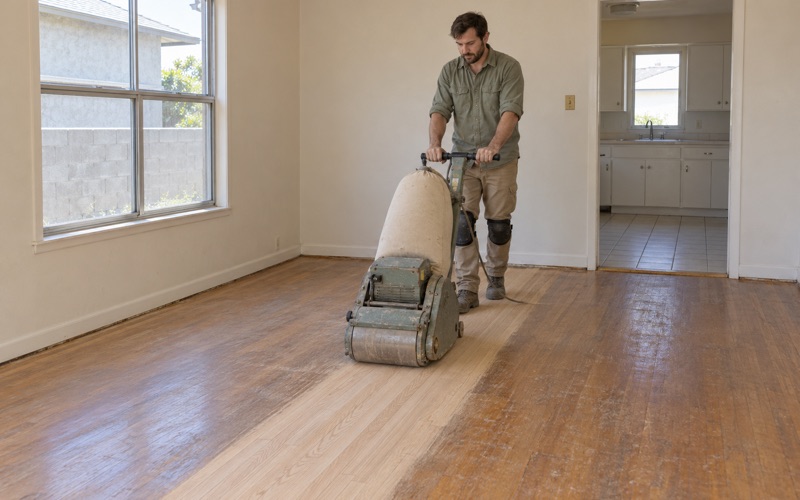
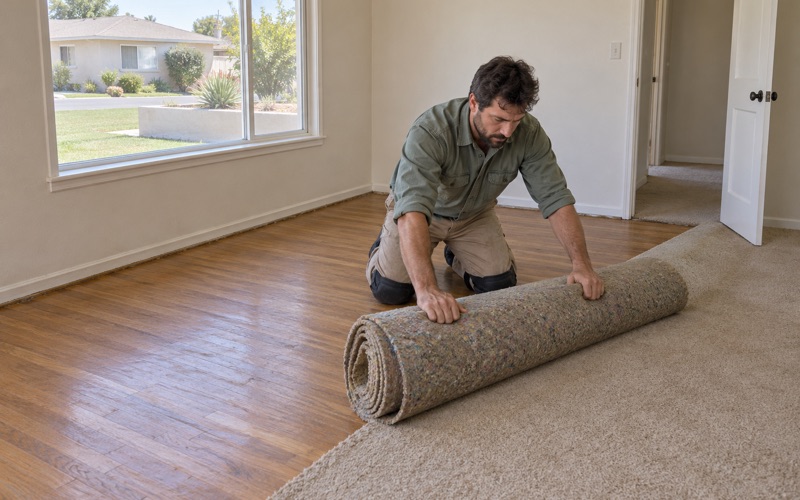
Hardwood in older houses was often covered at some point, and what comes back when the carpet comes up is frequently worth saving. We pull the pad, every staple and the carpet tack strip, then fill the holes before a drum sander touches the surface, so the floor refinishes evenly. Pet urine stains, blotchy stain from a past job and the orange color change of an aged finish on oak are all assessed and explained before sanding begins.
Sanding or a Screen and Recoat
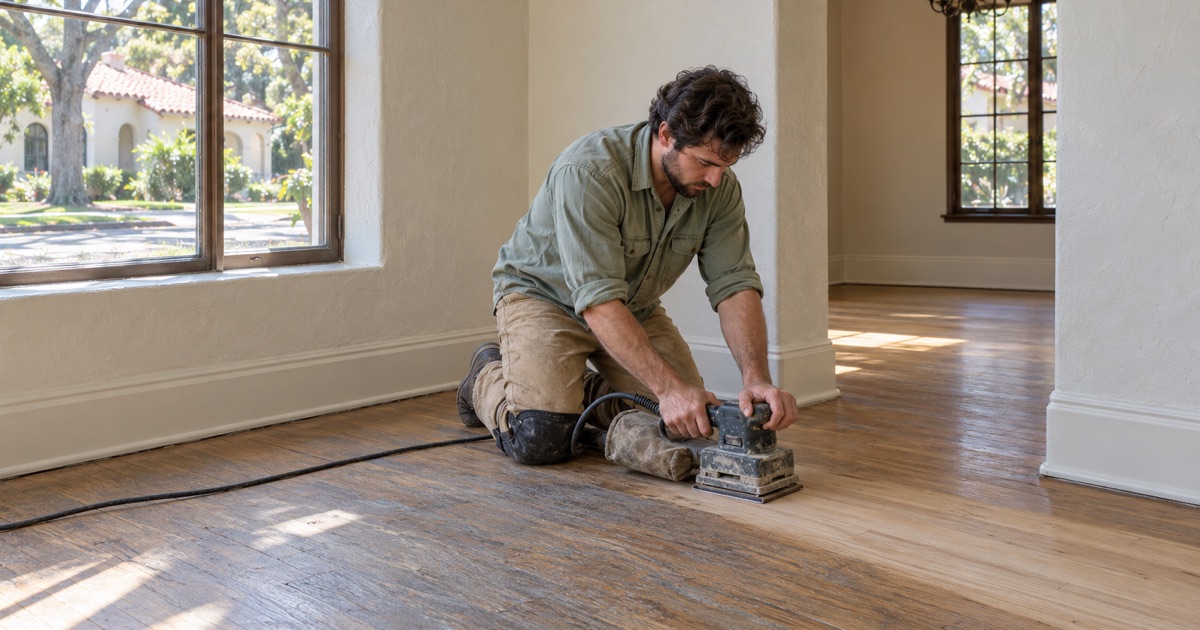
Not every tired floor needs a full sand. If the finish is worn but the wood beneath is sound, a screen and recoat freshens the surface without removing any wood, which matters on boards that may already have been sanded more than once. When a full sand is warranted, we use a drum sander, an edger and an orbital sander through a measured grit sequence, taking off only what the floor needs.
Lead, Old Tile and Dust
Anything built before 1978 gets lead-safe work practices under the EPA Renovation, Repair and Painting rule, which applies to the pre-war houses that make up most of the district. If old 9x9 floor tile or black mastic turns up under a later covering, we treat it as a possible asbestos question, and nothing is sanded or scraped until that is answered. For the sanding itself we use a dustless sanding system with containment, and you get a written cure schedule showing when each room can be walked on and furnished again.
Finishes Legal in the Air Basin
Santa Ana falls under the South Coast Air Quality Management District, where SCAQMD Rule 1113 sets a 275 g/L VOC limit for wood coatings. We choose among waterborne polyurethane, oil-modified polyurethane and hardwax oil products that meet it, and we talk through sheen level, since a satin or matte finish often sits more comfortably in a Period Revival room than high gloss. The finish you pick also sets how long each room stays out of use, and that goes on the cure schedule.
Repair Before Replacement in a Contributing Home
When a house has kept its character for most of a century, the most sensible floor work is usually the least invasive. We start from the assumption that existing boards stay and replace only what is truly gone, which is our own preference as a flooring contractor, not a requirement we are citing. If your home has a Mills Act agreement with the city, the city says its preservation conditions are set for each property’s specific needs, so that agreement is worth rereading before a large project.
Board Replacement and Weave-In Repair
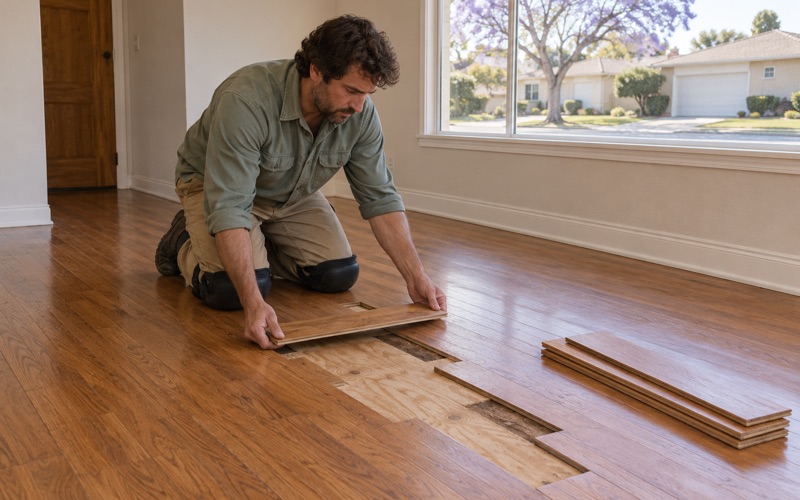
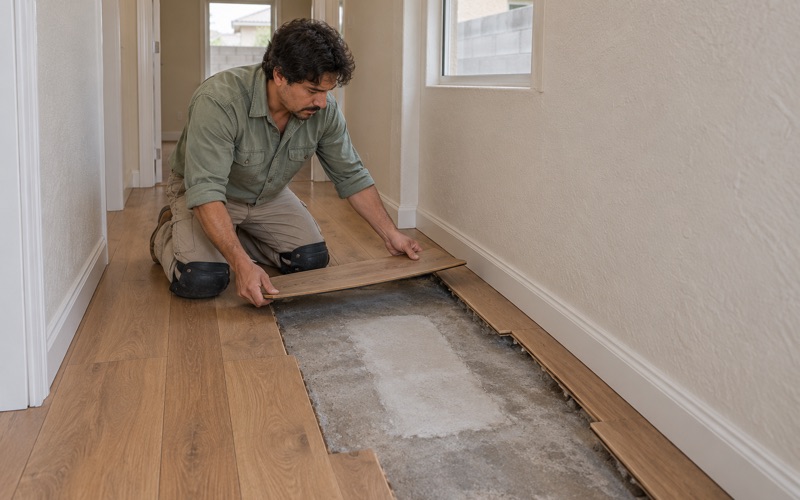
Where boards are split, stained through or damaged by drywood termites, we remove them one at a time and weave new ones into the existing field so the end joints stagger naturally. Termite frass near a baseboard, cupping, crowning, board gaps and squeaks each point to a different cause, and we find that cause before cutting anything. Where termites are the cause, we point that out so the house can be treated before new wood goes in. Sanded and finished with the rest of the room, a well-woven repair is hard to pick out.
Matching Boards That Are No Longer Made
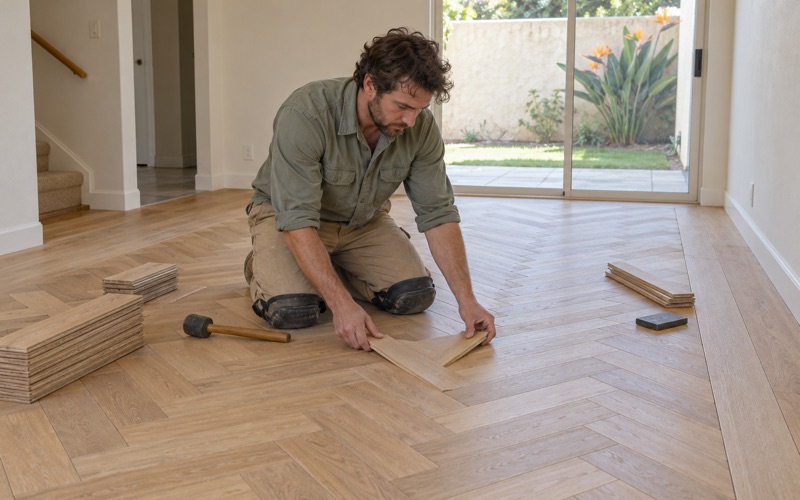
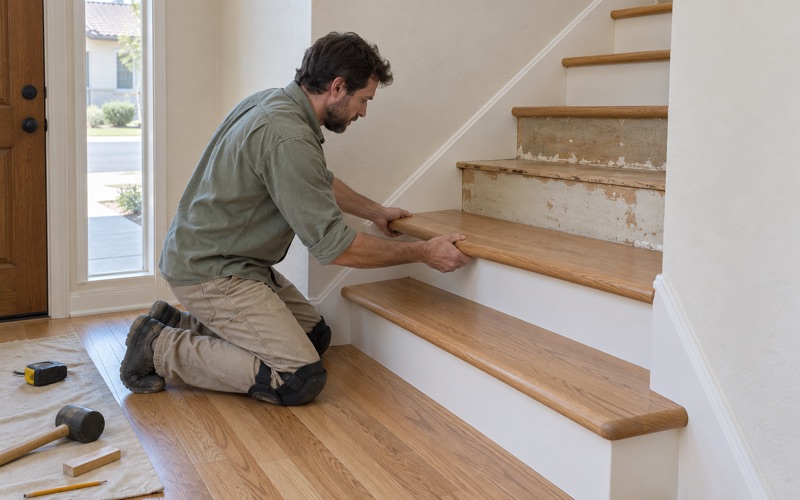
Older floors often use a width or grade that is hard to find today, so we match discontinued boards by species, width and finish before a repair begins. If the closest match is not close enough, we say so before the work rather than leaving a patch that reads as a patch. Stair treads, risers and nosing get the same attention and are priced per tread and riser rather than folded into a square-foot rate.
When Replacement Is the Honest Answer
Sometimes water damage or a failed earlier installation leaves too little sound wood to save. When that happens we trace the water to its source first and document the damage with photos and moisture readings an insurance adjuster can use. The new floor, whether solid white oak or another species chosen for its Janka hardness rating, is then picked to sit quietly in the house rather than follow the latest trend.
Santa Ana Beyond the Historic District
Floral Park is not typical of the city as a whole. Santa Ana, incorporated in 1886 and the Orange County seat since 1889, counts 83,701 housing units, and only 8.2 percent of them predate 1940. The bigger story is postwar: 73.9 percent of the city’s units were built before 1980, and the 1970s were the busiest single decade.
That split shows up in the work. A Floral Park job is usually about keeping what is there, while a house from the 1960s or 1970s is more often about what has been laid on top of the original floor since.
Floors Laid Over Concrete
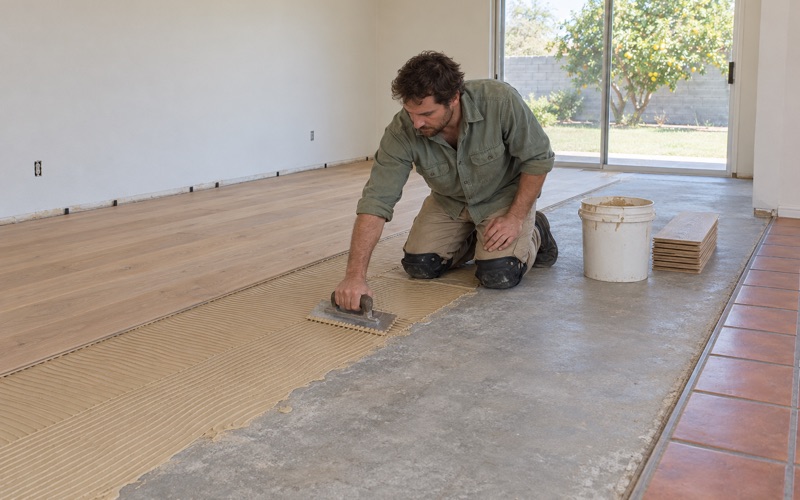
Where a postwar floor sits on concrete, we lift any old glued-down flooring and take the adhesive off before anything new is planned. The concrete is then tested with an ASTM F2170 in-situ relative humidity test or a calcium chloride moisture test, and the result helps decide the installation method and whether a vapor retarder belongs under the new floor. Engineered boards with a sound core and an adequate wear layer thickness are often the right choice over concrete, and we explain why when they are.
Slab Leaks and Repipes
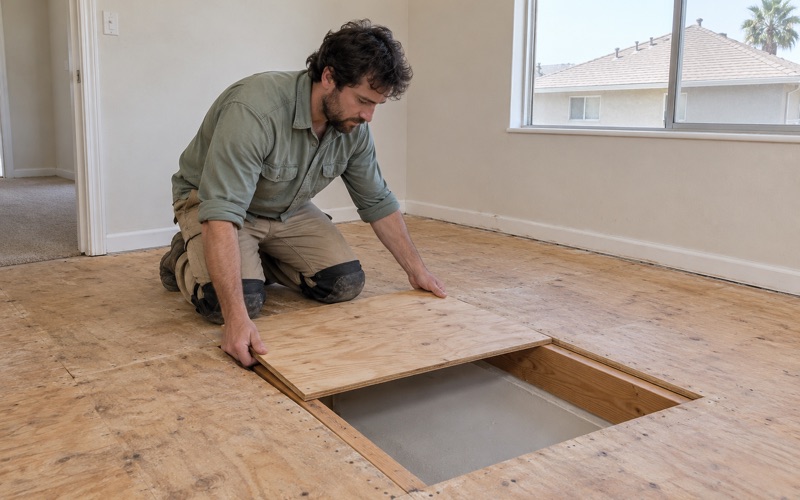
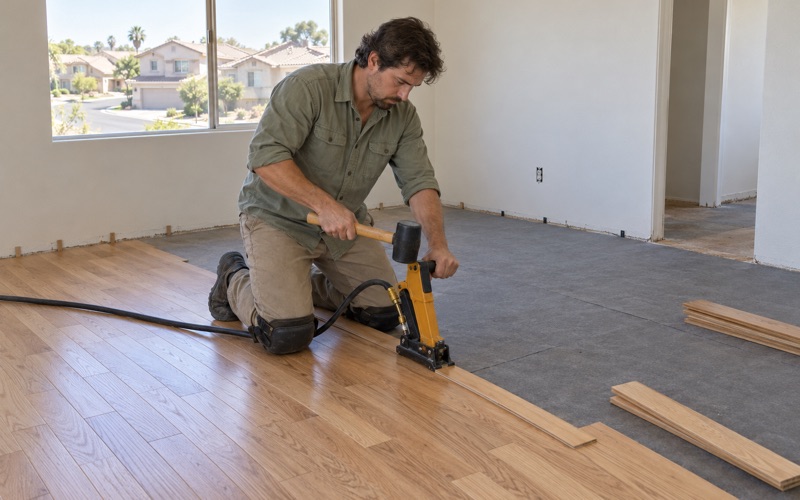
A slab leak or repipe can put a hole through a finished wood floor, so we plan the plumber’s access point with you before any boards are cut. Afterward we open and dry the area, recheck moisture content, and patch the floor back in with matched boards. New material acclimates before it goes down, following NWFA installation guidelines, so it settles at a stable moisture content for the house.
Condos and Upstairs Rooms
For upstairs rooms and condos, we choose acoustic underlayment with the neighbor below in mind and read the association’s own rules before a floor comes up. Alteration paperwork, underlayment ratings and work-hour limits are all settled before the job is scheduled. It keeps the work on good terms with the association and with the people living underneath it.
The Same Process Across the City
Wherever the house sits in Santa Ana, the process is the same: readings first, a price that matches what we found, and a plan built around how you live in the house during the work. We would rather spend an extra hour measuring than guess, because a guess on a floor tends to show up months later as a gap, a cup or a callback.
- 20+ Years of Floor Work
- Written, Itemized Estimates
- Moisture Readings Recorded