
Westminster Wood Flooring handles projects to replace carpet with hardwood in Westminster, CA, serving surrounding cities including Midway City, Garden Grove, Stanton, Fountain Valley and Huntington Beach. In 20+ years of pulling up carpet, we have opened rooms that held hardwood in good condition under the pad, rooms with plywood that needed repair first, and slabs that needed testing before any wood could go down, and each of those calls for a different plan.
That is why every carpet-to-hardwood job starts by finding out what is underneath. We lift the carpet and pad, pull every staple and tack strip, fill the holes and then decide, with you, whether the room needs a refinish, a repair or a new floor. The written, itemized estimate breaks out removal, subfloor work, new material, stairs and transitions, so you can see what each part costs.
What Is Under the Carpet
Hardwood Waiting to Be Refinished
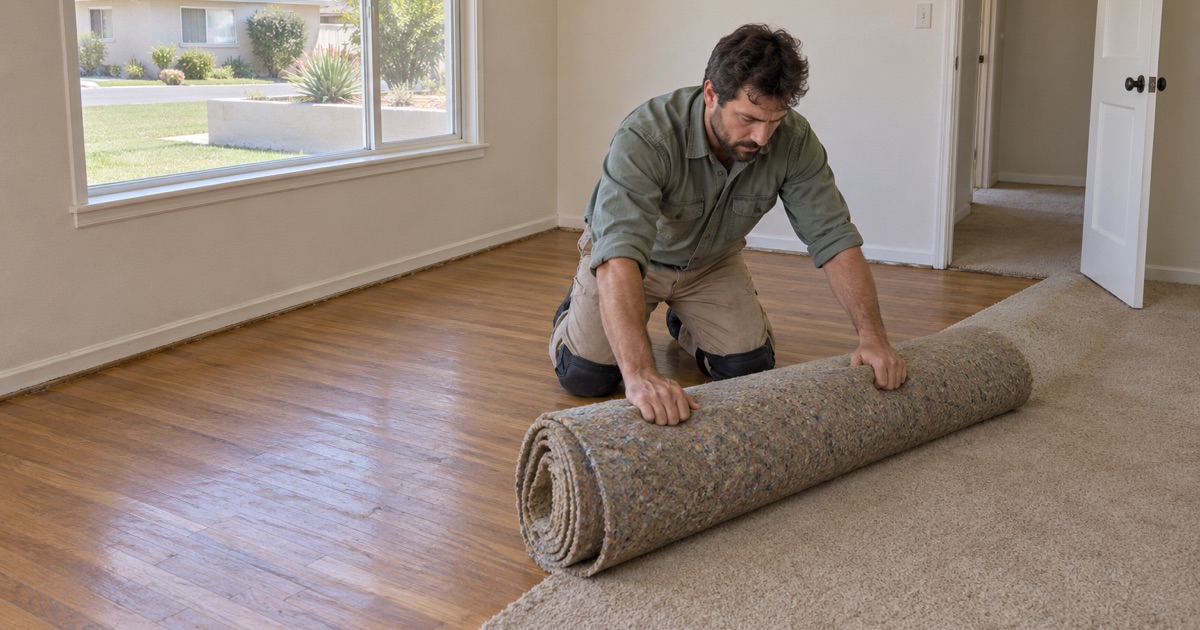
Some carpeted houses have hardwood underneath that was covered for style, not because it failed, and it is often in better shape than you would expect after years protected under pad. What it usually carries is damage from the carpet itself: a grid of staple holes, nail holes from the tack strip along the walls and sometimes pad glued to the surface. Once those are cleaned up, the floor is sanded and refinished like any other hardwood, and the room gets a real wood floor without the cost of new material.
Plywood or Particleboard Subfloor
If the carpet sat directly on plywood or particleboard, there is no hardwood to save, but the subfloor still tells us a lot. We check it for soft spots, water-swollen edges, loose panels and squeaks, especially near bathrooms, kitchens and exterior doors. Any damaged sheathing is cut out and replaced before a finish floor goes down, since new boards laid over a weak spot will flex, squeak and loosen within a season.
Concrete Under the Carpet
When carpet comes off a concrete slab, it leaves tack strip nails, adhesive from the pad and sometimes old tile or glued-down flooring beneath that. We remove all of it, grind and patch the slab flat and test its moisture before any wood is ordered. Old 9x9 tile or black mastic found under the carpet is tested for asbestos before anyone scrapes it, so an older layer is handled correctly.
Removing Carpet, Pad and Tack Strip
Carpet and Pad Removal
Carpet is cut into manageable strips, rolled and hauled away with the pad. Pad glued to hardwood or concrete is scraped off carefully so the surface underneath is not gouged. We protect doorways, walls and the rest of the house during removal, because old carpet holds years of dust that should leave the house rather than settle in the next room.
Staples, Tack Strip and Nail Holes
Carpet installers staple pad every few inches, and tack strip is nailed around the perimeter of every room. On hardwood, each staple is pulled rather than broken off, the tack strip nails are removed without splitting board edges, and the holes are filled with a color-matched filler before sanding. Skipping this step leaves dark dots and lines under a clear finish that are impossible to hide later.
Planning Floor Height and Door Clearance
Carpet and pad sit at a certain height, and the new floor will not match it exactly. We measure before removal and plan the finished height of the hardwood and any underlayment against doors, appliance openings, cabinets and the floors in adjoining rooms. Doors are trimmed where needed, and the plan is written down before the first board goes in.
New Hardwood Where the Carpet Was
Solid or Engineered Hardwood
Where there is no hardwood to save, the choice between solid and engineered depends on the subfloor. Solid hardwood is nailed over plywood and can be sanded many times over its life. Engineered hardwood, with its stable layered core, is the usual choice over concrete, either glued down or floated. We explain wear layer thickness, species and width for each option on the estimate.
Acclimation and Moisture Readings
New wood needs to match the moisture conditions of the house before it is installed. We check the flooring and the subfloor with a moisture meter, follow the manufacturer’s acclimation requirement and write the readings down. A floor installed too wet or too dry is the most common cause of gaps and cupping in the months after a carpet-to-hardwood switch.
Condos and Upstairs Bedrooms
Carpet is often the reason a condo or upstairs unit is quiet for the neighbor below, and many associations require a specific acoustic underlayment and board approval before carpet can be replaced with wood. We read the association’s rules and underlayment ratings first and help with the alteration paperwork, so the new floor is approved before any carpet comes up.
Stairs, Transitions and Finishing
Replacing Carpeted Stairs With Hardwood
Carpeted stairs usually sit on rough treads that were never meant to be seen. We remove the carpet and tack strip, then fit new hardwood treads, risers and nosings, priced per tread and riser. The stairs are stained and finished to match the floor above and below, so the whole run reads as one project.
Transitions to Tile and Other Rooms
Where new hardwood meets tile, vinyl or remaining carpet, a reducer strip, T-molding or threshold makes the change smooth and deliberate. We cut and finish each transition to match the new floor. Baseboards or shoe molding cover the expansion gap along the walls and finish the room cleanly.
- 20+ Years of Floor Work
- Written, Itemized Estimates
- Moisture Readings Recorded