Westminster Wood Flooring has spent more than 20 years on wood flooring in Midway City and the surrounding part of Orange County, and here the person who calls us is often an owner who rents the place out rather than the household walking on the boards. A move-out has just happened, a house sits empty between leases, or a worn hallway needs attention before new tenants arrive. We plan the job around that calendar.
Every job starts with measurement instead of a guess. We read the moisture content of the wood, and of any concrete underneath, before a single carton is ordered, and we check the subfloor for soft or water-swollen spots before the finish floor gets a price. The readings go on paper along with the estimate.
That estimate is written and itemized, line by line, so an owner can keep it with the lease file, compare it against a security deposit accounting, or hand it to an insurance adjuster after a leak. Refinishing, new installation, board repairs and stairs all come from the same crew.
A Renter-Majority Community Without a City Hall
Midway City is an unincorporated community, and it rents far more than it owns. Census figures from the 2024 five-year American Community Survey count 1,893 of its 2,615 occupied units as renter-occupied, which is 72.4 percent. Just over one household in four owns the place it lives in.
That pattern is not an accident of one neighborhood. The County of Orange’s housing element, in its January 2025 adoption draft, notes that the unincorporated islands in central Orange County generally correspond with areas that have higher rates of renters than homeowners. Midway City is one of those islands, and it is actually four separate pieces of county land left standing after neighboring cities annexed around them.
For floor work, that split decides who we answer to. When the owner of a rented house lives elsewhere, we send the photos, readings and written estimate by email and arrange access days with the tenant, so the owner does not have to drive over for a walkthrough.
No City Government Between You and the County
There is no city hall here. The County of Orange, through its Board of Supervisors, is the government, and the community’s chamber of commerce and homeowners association work together in place of a city council. For building questions on private property in unincorporated Orange County, the office is OC Development Services, part of OC Public Works, which runs building plan check and permits for these areas.
The county’s list of work it typically reviews includes interior renovations and remodels, and it names no floor-covering exemption or requirement either way. When a floor job is part of a bigger remodel, we send the owner to that office with the scope in writing before anything is scheduled, rather than guessing at the answer ourselves.
A Name Taken From the Map
The name is literal: Midway City sits horizontally midway between Seal Beach to the west and Santa Ana to the east. The land was subdivided starting in 1923, and housing has been added in waves ever since, a history we come back to when we look at the floors themselves.
Looking for wood-flooring closer to Garden Grove? See Wood-Flooring Services in Garden Grove.
Floors in Rented Houses and Small Buildings
Renting here is not confined to apartment buildings. In one-unit detached houses, the same ACS 2024 tables count 476 renter households and 486 owner households, so about half of the occupied detached houses in Midway City are rented. The rest of the rental stock runs from attached homes and duplexes to three- and four-unit buildings and larger complexes.
For us that means a common decision-maker is a landlord looking at a whole house, not an apartment manager ordering a hundred identical units. A rented single-family home gets the same wood floor questions an owner-occupied one does: refinish or replace, which species, which finish. The difference is who pays, who approves, and how many days the house can sit without rent.
Buildings of three or four units hold 382 renter households here, more than any other multi-unit size in the same count. Where one owner holds a whole small building, it is practical to refinish units one at a time as leases end while keeping species, stain color and sheen consistent. We keep the product and color records on file so the next unit matches the last one.
Wear That Tenants Leave Behind
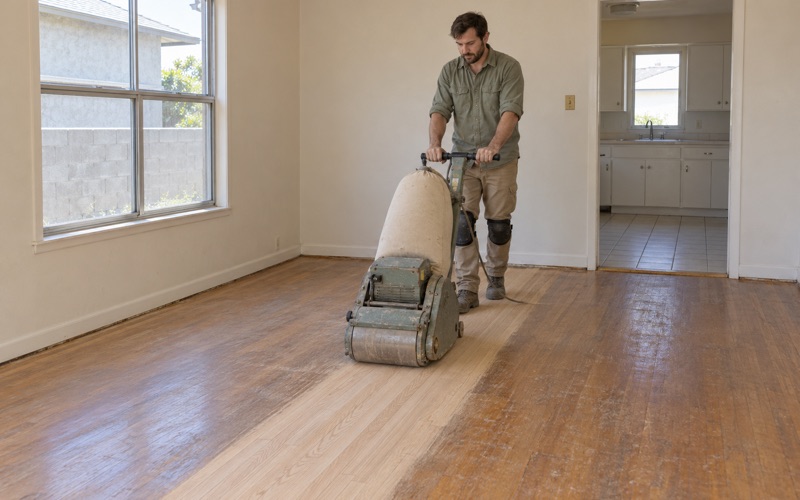
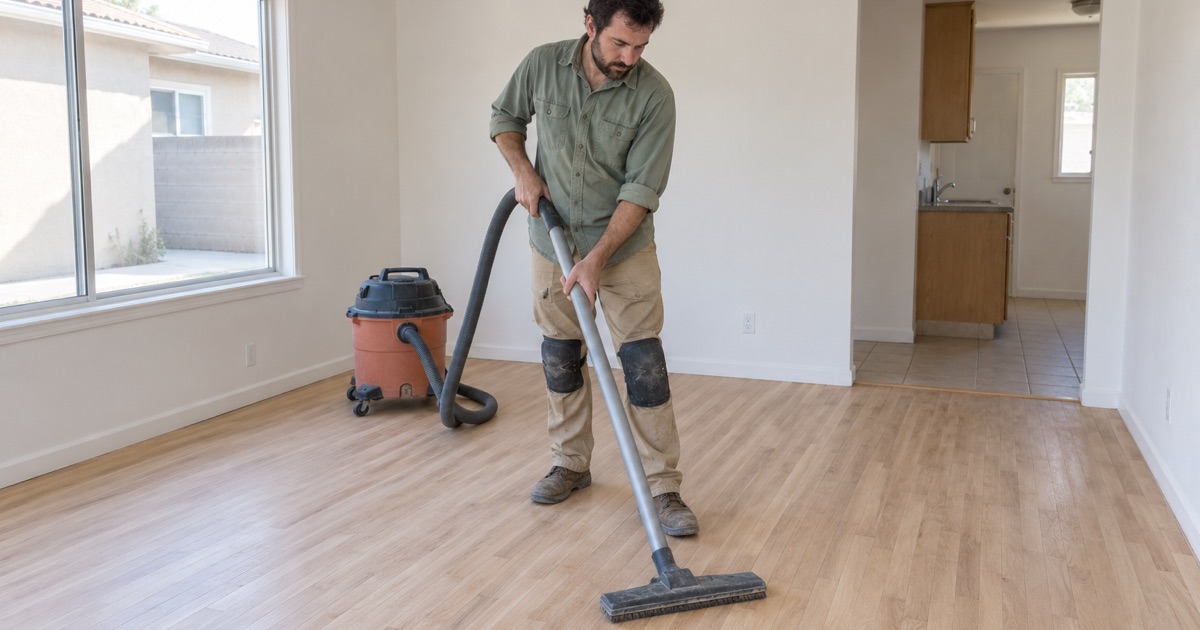
Between leases we see the same patterns: traffic lanes worn through the finish in hallways, pet urine stains near doors, gouges where furniture was dragged, and gray patches where water sat under a plant. A screen and recoat can restore sheen on a floor whose finish is dull but intact. Once the wear reaches bare wood or the stain has soaked into the boards, a full sand with a drum sander, edger and a proper grit sequence is the honest answer.
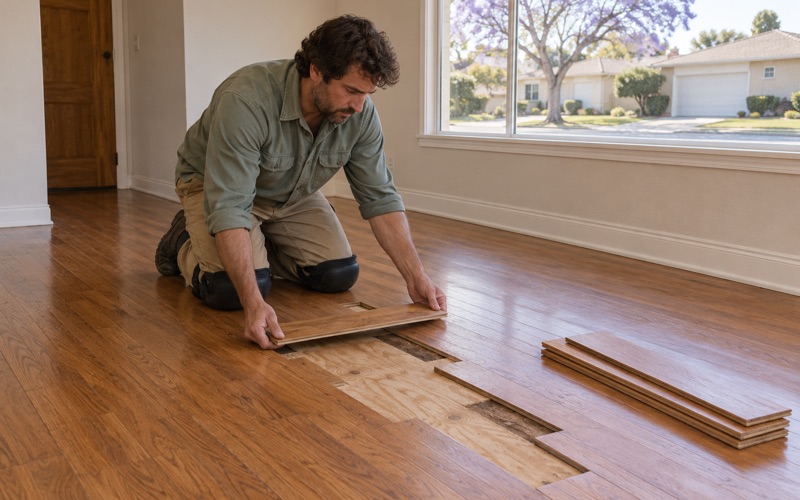
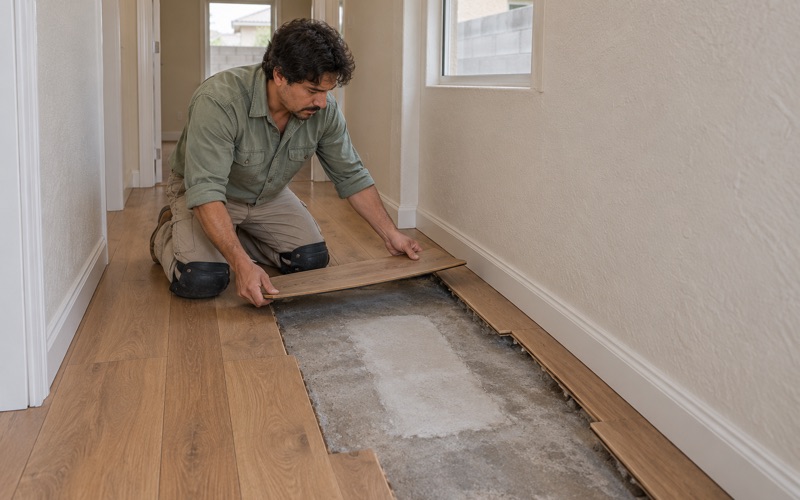
Deep pet stains often do not sand out at all, and we say so before sanding rather than after. In that case we cut out the affected boards and weave in replacements, matched by species, width and finish so the repair does not read as a patch, even when the original product has been discontinued.
Paperwork a Landlord Can Use
California’s security deposit statute, Civil Code 1950.5, separates damage from normal wear and tear, and an owner deciding what to charge needs a clear record of which was which. Our itemized estimates separate refinishing a worn but sound floor from replacing boards that were damaged, with photos and moisture readings attached when water is involved.
Planning Floor Work Between Tenants
Turnover is the best window a landlord gets. An empty house can be sanded end to end with no furniture to shuffle, and the finish can cure without anyone walking on it. We ask for the move-out date and the move-in date first, then build the schedule backward from the day keys change hands.
Finishes That Fit a Short Window
Finish choice drives the calendar more than anything else. Waterborne polyurethane dries faster and carries less odor than oil-modified polyurethane, which suits a unit that has to be shown and leased quickly; a hardwax oil finish is easier to spot-repair later but asks more of whoever maintains it. Whatever we use, it is a product legal to apply in the South Coast air basin, where SCAQMD Rule 1113 caps wood coatings at 275 grams per liter of VOC.
Every job ends with a written cure schedule showing when each room can take foot traffic, when furniture can go back, and when rugs can go down. A property manager can forward that sheet to the incoming tenant so nobody drags a sofa across a floor that is still hardening.
Leaks, Repipes and Insurance Claims
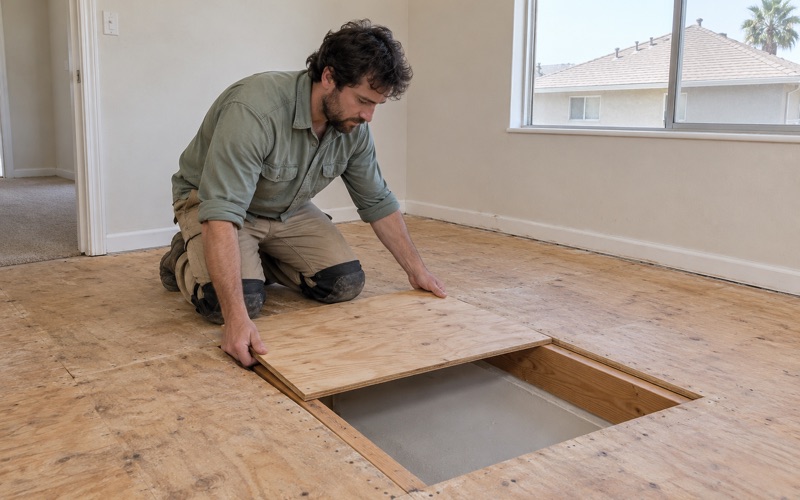
A leak can take a rental out of service faster than years of wear. When water gets under wood, we trace it back to its source, document the damage with photos and moisture meter readings an insurance adjuster can use, and open and dry the floor before patching. If a slab leak or repipe is coming, we plan the plumber’s access hole with them before any boards are cut, so the patch afterward is as small as it can be.
When Someone Still Lives There
Not every job waits for a vacancy. Repairs after a leak, a board replacement in a hallway, or a stair refinish sometimes happen with a tenant at home, and the census counts a sizable share of older renters here: 28.9 percent of Midway City’s renter householders are 65 or older. For an occupied unit we set up dust containment, work room by room, and keep a clear path to the kitchen, bath and front door.
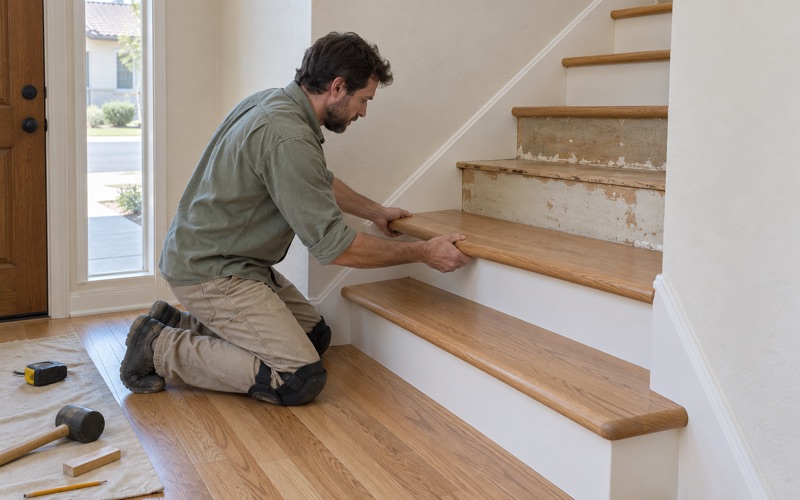
Stairs are priced per tread and riser rather than folded into a square-foot number, so an owner can schedule them on their own if the rest of the house has to wait for the next vacancy. Nosing and treads are sanded by hand where a machine cannot reach.
Housing From the 1950s Through the 2010s
Midway City’s housing was not built in one wave. Of its 2,862 housing units, 35.0 percent went up before 1960, with the single biggest decade being the 1950s at 26.4 percent, while 16.3 percent were built in 2000 or later. A landlord with two properties a few streets apart can easily be dealing with floors built decades apart.
Postwar Houses and Older Floors
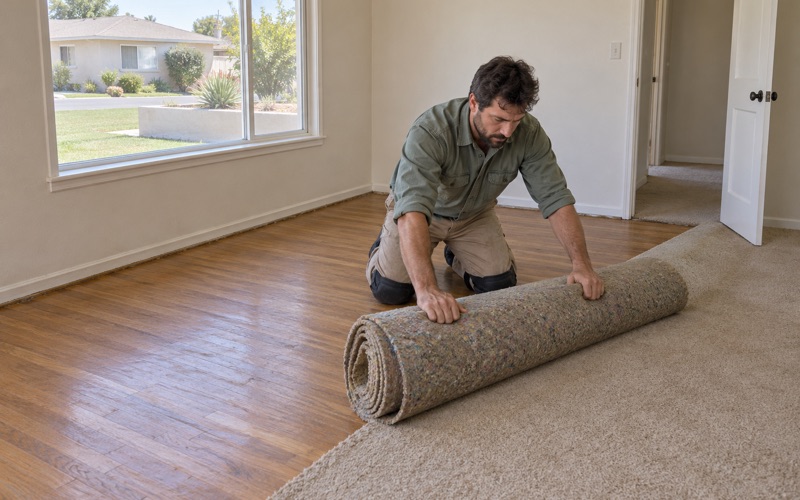
In the older houses, the first job is finding out what is actually under the carpet. We lift the pad, pull the tack strip and staples, and fill the holes before any sanding, so whatever wood turns up refinishes clean. Sometimes the answer is not wood at all but old floor tile, and 9x9 tile laid in black mastic is treated as a possible asbestos question, with an asbestos survey before anything is scraped or sanded.
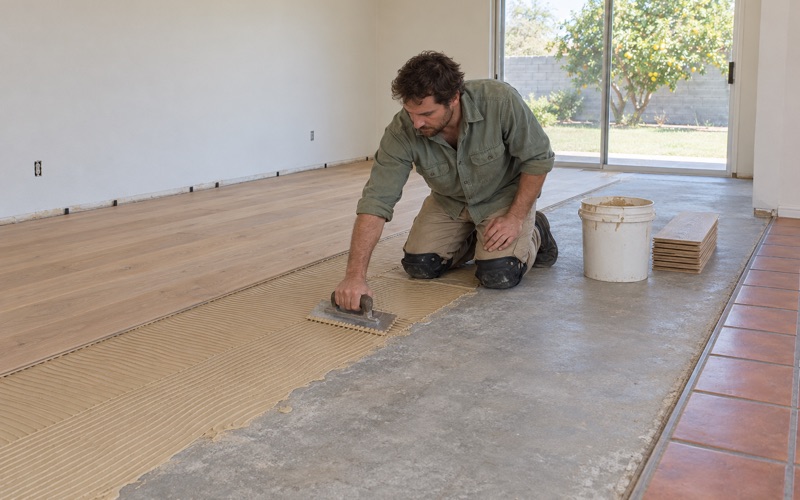
Those pre-1960 units, and many built later, all predate 1978, so we follow lead-safe work practices under the EPA Renovation, Repair and Painting rule when sanding or disturbing painted trim and shoe molding. Old glued-down flooring comes off with its adhesive, and a concrete subfloor is tested before anything new goes down, using a calcium chloride test or an ASTM F2170 in-situ relative humidity test.
Attached Homes and Upstairs Floors
Attached homes and multi-unit buildings raise different questions. In any unit with a neighbor below, an upstairs install needs acoustic underlayment chosen with that neighbor in mind, and the association’s alteration rules and work-hour limits read before any floor comes up. Where the existing floor is engineered, we check the wear layer thickness before promising a refinish, because a thin wear layer may allow one light sanding or none.
Another 217 units, 7.6 percent of the housing stock, are mobile homes. Their floors sit on factory decking that we check for water swelling and soft spots before anything new is laid over it.
Choosing Wood for a Rental
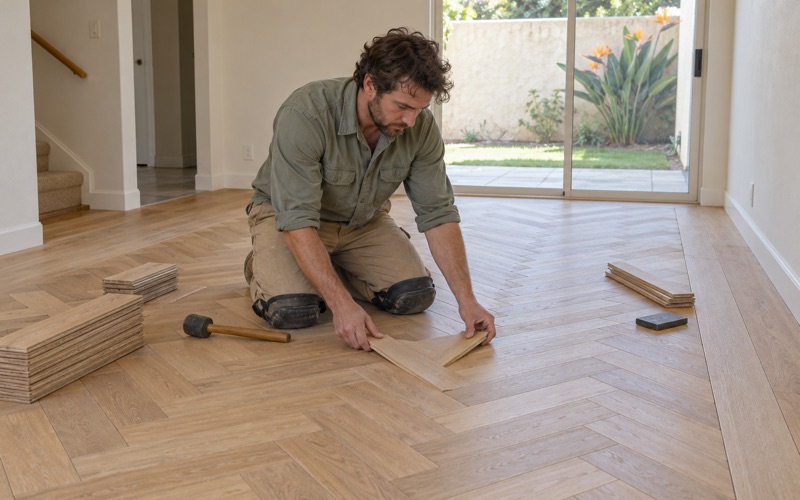
For a house that will see several tenants, we steer owners toward species and finishes that hold up. Janka hardness ratings help here: white oak and hickory resist dents better than softer choices, and a matte or satin sheen level hides the fine scratches that a high gloss shows within weeks. New boards are acclimated and their moisture content checked against the subfloor before installation, following NWFA installation guidelines.
Whatever the era, the sequence stays the same: measure moisture, check the subfloor, record what we find, then price the floor. That order is what lets a landlord compare a refinish against a replacement on paper before the house goes back on the market.
- 20+ Years of Floor Work
- Written, Itemized Estimates
- Moisture Readings Recorded