Westminster Wood Flooring brings more than 20 years of wood-flooring in Los Alamitos homes and rental units to every job, from a single water-stained room to a full install. We start with a wood moisture meter rather than a sample board, reading the boards and, where a floor sits over concrete, the concrete as well. Those readings are written down before any material is ordered, so the numbers a decision rests on are on paper.
Much of our work here begins after water has already reached a floor, whether from a failed supply line, a leak under the floor or a storm. We trace the source, photograph the damage and log moisture content across the room, so an adjuster or a landlord has a record built from readings rather than impressions. The subfloor gets checked before anything is priced, because soft sheathing found after the estimate is how a small repair turns into a callback.
This page covers what makes that work different in this city: a flood study built around one concrete channel, an older housing stock, and what an honest floor assessment looks like when water does get in. It is written for owners and landlords deciding whether a floor can be saved or has to come up.
Wood Floors and the Carbon Creek Channel Study
FEMA’s Flood Insurance Study for Orange County, revised March 21, 2019, lists the flood zone designations for each community it covers. For the City of Los Alamitos, the table reads A and X. The study’s list of flooding sources ties the city to one waterway, the Carbon Creek Channel, a concrete flood-control channel whose studied reach runs 14.9 miles to its confluence with the Coyote Creek Channel.
Los Alamitos is one of several Orange County cities named on that row, so the channel study was written for a long corridor rather than for this city’s streets. The Zone A attached to the Carbon Creek row comes from an analysis dated 1978.
Zone A Without an Elevation
Zone A, in FEMA’s own legend, marks an area subject to the 1-percent annual chance flood where the base flood elevation was not determined. In plain terms, the study says water could reach a mapped area in a large storm but gives no figure for how high it would stand. That missing number is the part that matters for a floor, since the gap between a finished floor and a flood elevation is what decides how much of a room is at stake.
No Levee on the List
The study’s levee table carries no row for Los Alamitos at all. We read that as an absence rather than a finding: no levee is listed as standing between this city and the channel. FEMA’s notes on the Carbon Creek Channel blame its flooding problems on inadequate culverts and channel capacity, and where the study describes overtopping farther up the channel, it puts the resulting depth at less than 1 foot.
What the Study Does Not Say
None of this places a particular street or house in any zone; that answer lives on FEMA’s flood map panels and with the city, and we point owners there rather than guess. What the study does establish is the general shape of the risk: flooding tied to a channel, studied decades ago, with no elevation attached. That is enough to justify a few extra questions whenever we open up a floor here.
Looking for wood-flooring closer to Cypress? See Wood-Flooring Services in Cypress.
An Old Channel Study and an Older House
Los Alamitos was incorporated in March 1960, and a large share of its homes date from the decades on either side of that year. Of the city’s 4,623 housing units, 70.5 percent were built before 1980, and the single largest decade is the 1960s, with 1,302 units or 28.2 percent. Only 10.4 percent date from 2000 or later.
For a floor, that age matters in a few practical ways. A house from the 1960s may have had its finish floor replaced more than once, each layer leaving its own adhesive, staples or tack strip behind, and anything built before 1978 brings the EPA Renovation, Repair and Painting rule into play when painted trim or baseboard is disturbed. We use lead-safe work practices on those houses as a matter of course.
Put the two facts side by side and the limits of the study become clear. A 1978 analysis with no elevation cannot say whether a particular 1960s living room sits a few inches or a few feet above where water would stand, and it says nothing about any one address. What we can measure is the floor itself: its moisture content, the condition of whatever is beneath it and how it has reacted to past water.
Layers Under the Carpet
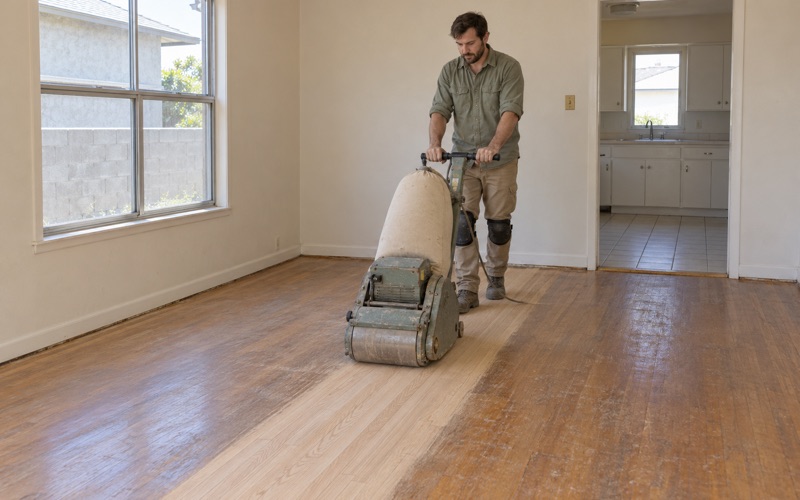
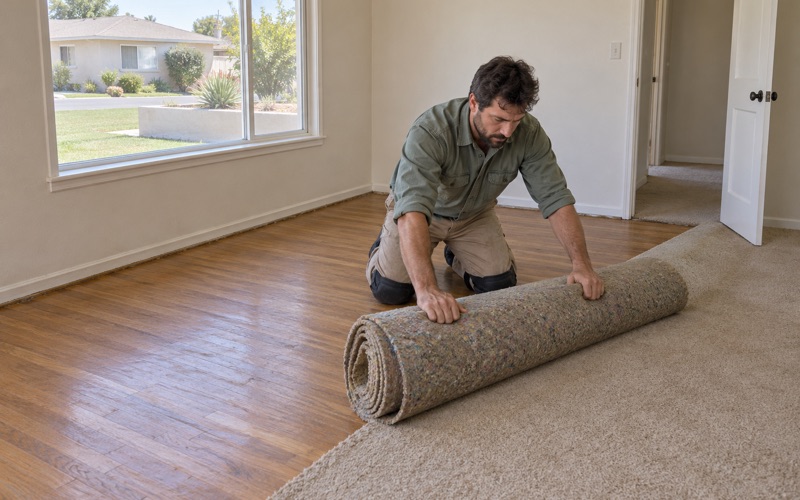
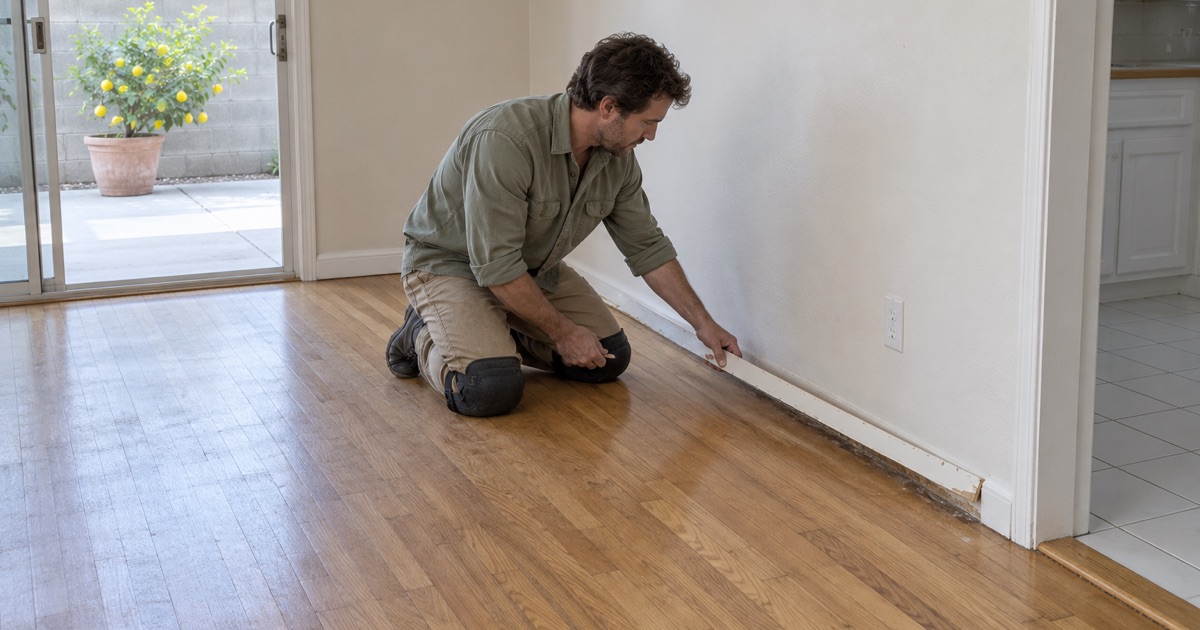
Carpet in older Los Alamitos homes can hide almost anything, from a hardwood floor to 9x9 tile set in black mastic. We treat old tile and mastic as a possible asbestos question before anything is sanded or scraped, and we do not guess at what is underneath until the carpet is up. Where wood does turn up, we pull the pad, staples and carpet tack strip and fill the holes before the drum sander touches it, so the refinish comes out clean.
Older houses also turn up drywood termite damage often enough that we look for it whenever boards come up. Small piles of termite frass along a baseboard are a reason to have the house inspected before new wood goes in, since a fresh floor laid over active damage is money spent twice.
Rentals and Small Buildings
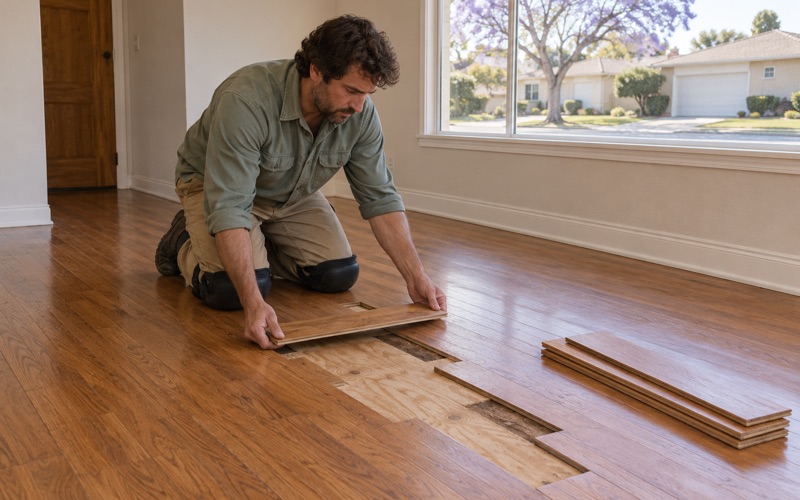
Renters occupy 57.6 percent of the city’s occupied units, and a good share of them live in buildings of three to nine units. For a landlord, a floor repair between tenants has to be quick, documented and matched to the boards around it. We match discontinued boards by species, width and finish before cutting in a repair, and we write itemized estimates an owner can keep with the unit’s records.
Assessing a Wood Floor After Water Gets In
When water reaches a wood floor, the first job is finding where it came from, whether that is a supply line, a water heater, a plumbing leak below the floor or runoff under a door. Drying a floor while the source is still feeding it only moves the damage around. We confirm the source is stopped before we take a single reading as a baseline.
Reading the Boards
Wet hardwood tells its story in shape. Cupping, where board edges rise above the centers, usually means moisture is coming from below; crowning, the reverse, often shows up when a cupped floor was sanded flat before it dried; buckling, where boards lift off the subfloor, means the swelling ran out of room at the expansion gap. We map moisture content room by room with a wood moisture meter and compare wet areas against a dry reference in the same house.
What Sits Underneath
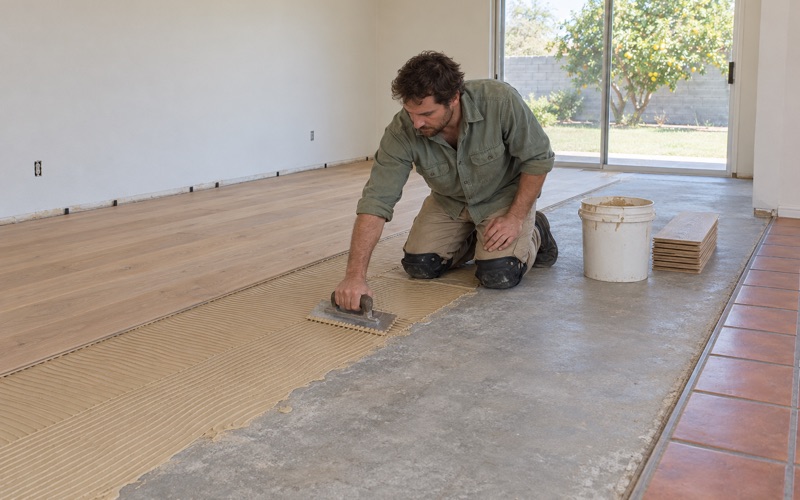
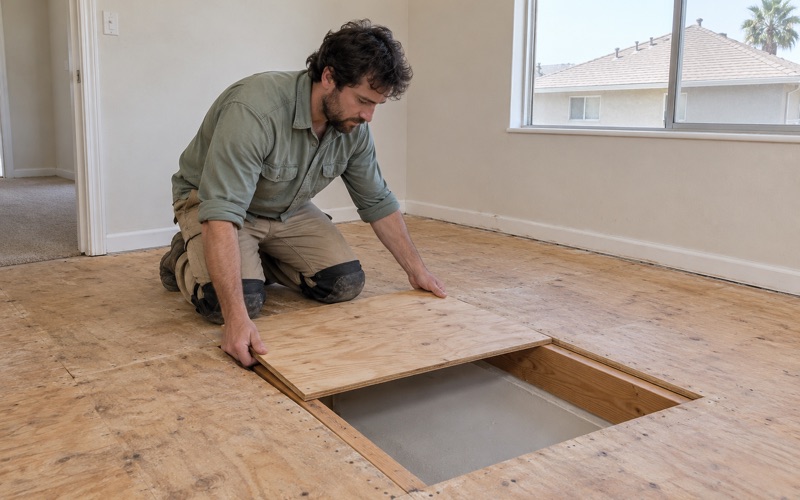
The finish floor is only half the assessment. On a wood subfloor we look for swollen or soft sheathing, particleboard decking that has lost its strength and any sign the moisture reached a floor joist. Where a floor was glued or floated over concrete, we test the concrete with an ASTM F2170 in-situ relative humidity test or a calcium chloride test before deciding anything new can go down.
Save, Repair or Replace
Some floors come back once they dry to their normal moisture content, and some cupping settles enough to sand and refinish. Others have delaminated, stained black at the joints or pulled loose from the subfloor, and those need board replacement or a weave-in repair. We put the answer in writing, with photographs and the readings behind it, in a form an insurance adjuster or a property owner can check line by line.
Around a Leak Repair
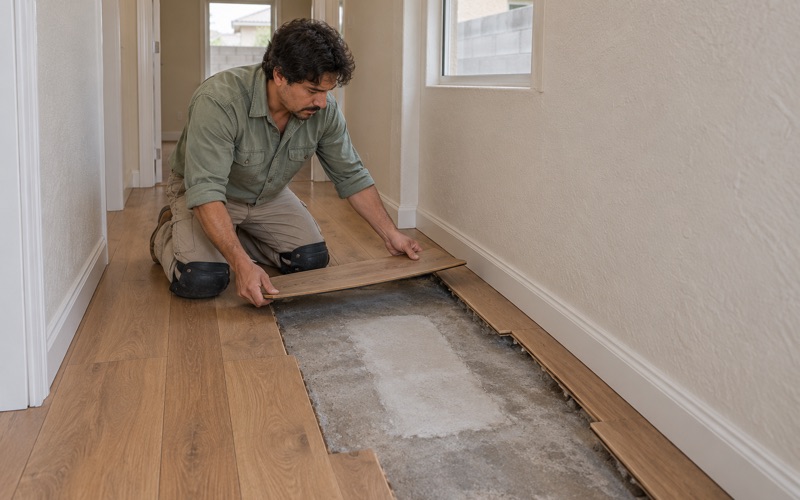
Many water-damaged floors come with a plumber’s access hole attached, and we would rather plan that opening than patch around a surprise. We settle where the cut goes before boards come up, dry the surrounding area, and then patch the floor back in with boards matched to the rest of the room. Done in that order, the repair reads as part of the floor rather than as a patch.
Planning Floor Work in Los Alamitos
Construction permits in Los Alamitos come from the Development Services Department’s Building and Safety Division, which runs an online Building Permit Center and a walk-in counter open 7:30 a.m. to 12:30 p.m., Monday through Thursday. Whether a given floor job needs one is a question for that division, and we put it to them before the work is scheduled.
Finishes and Air Rules
Los Alamitos falls under the South Coast Air Quality Management District, which covers all of Orange County. SCAQMD Rule 1113 caps wood coatings at 275 g/L of VOC, so every finish we apply, whether a waterborne polyurethane, an oil-modified polyurethane or a hardwax oil, is chosen from products legal in the basin. We pair that with a dustless sanding system and a written cure schedule that tells a household when each room can take foot traffic and when furniture can go back.
Timing, Acclimation and Neighbors
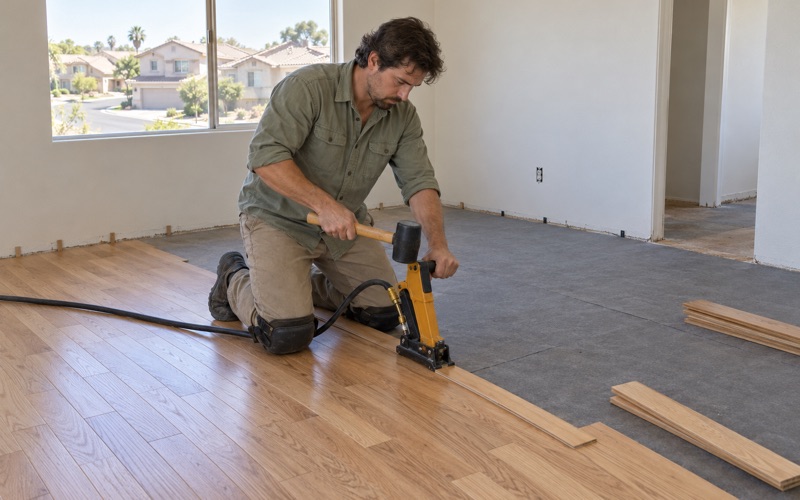
The city sits in the National Weather Service’s Orange County Inland forecast zone rather than the coastal one. For new wood, that is a reason to measure rather than assume: we let boards acclimate in the rooms where they will be installed and check their moisture content against the subfloor before a single board is nailed or glued, following NWFA installation guidelines. On upstairs units we choose acoustic underlayment with the neighbor below in mind and read the association’s rules before any floor comes up.
Choosing Wood for Hard Use
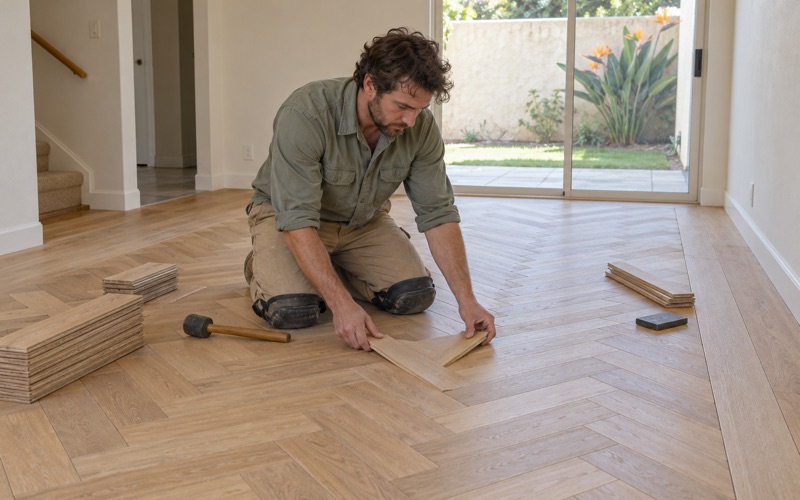
For a rental or a busy family house, species choice is a practical decision rather than a style one. Red oak and white oak take stain predictably and sit mid-range on the Janka hardness rating, while hickory rates harder and maple tends to stain blotchy when the prep is rushed. On engineered floors, wear layer thickness decides how many times the floor can be sanded before it has to be replaced.
Stairs and Line-Item Estimates
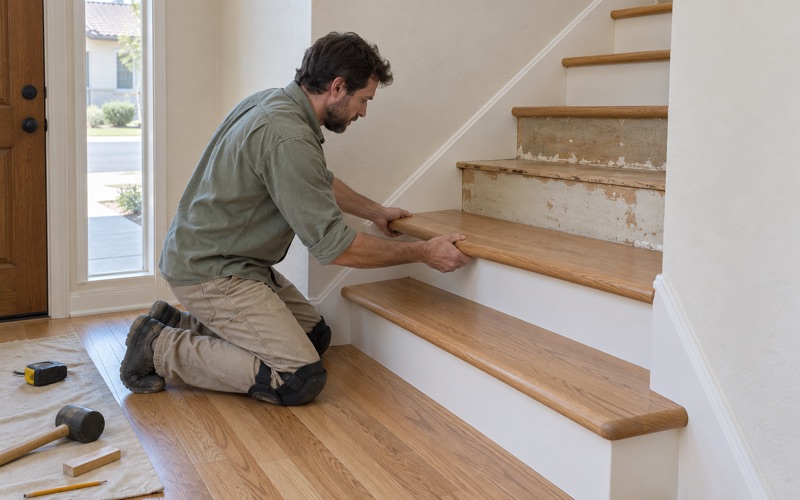
Stairs are priced per tread and riser rather than buried in a square-foot figure, and each line on the estimate names the work it pays for. That way a homeowner, a landlord or an adjuster can see what each part of the job costs before it starts.
- 20+ Years of Floor Work
- Written, Itemized Estimates
- Moisture Readings Recorded