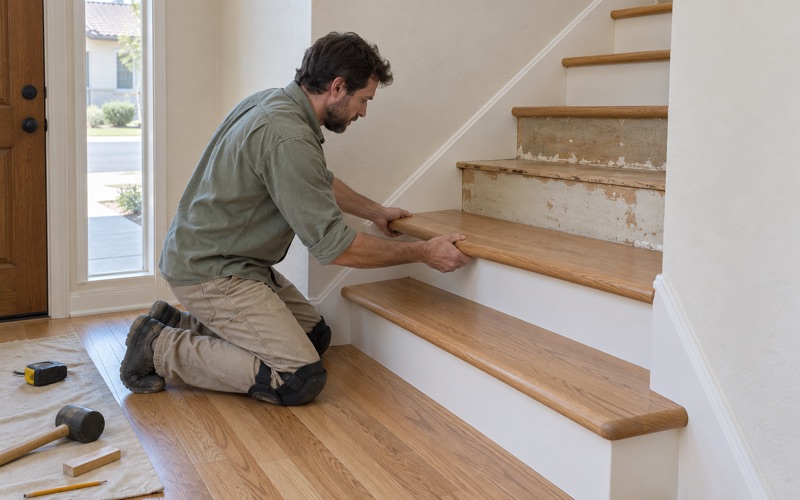
Westminster Wood Flooring brings more than 20 years of wood-flooring experience to Long Beach homeowners, with much of our attention going to older houses whose floors have already been sanded, covered, patched or neglected by earlier owners. We repair damaged boards, refinish worn surfaces, and install new hardwood and engineered floors where a room needs to start over. Every job begins with the same question: what is actually under the finish, and how much life does it have left?
That question gets answered with instruments and a flashlight rather than a guess. We read moisture content in the wood with a meter and write the readings down, then lift a corner of carpet wherever it covers a floor to see what is waiting under it. The estimate you get is written and itemized, so a seller, landlord or insurance adjuster can read it line by line.
How the Oil Boom Built Long Beach’s Houses
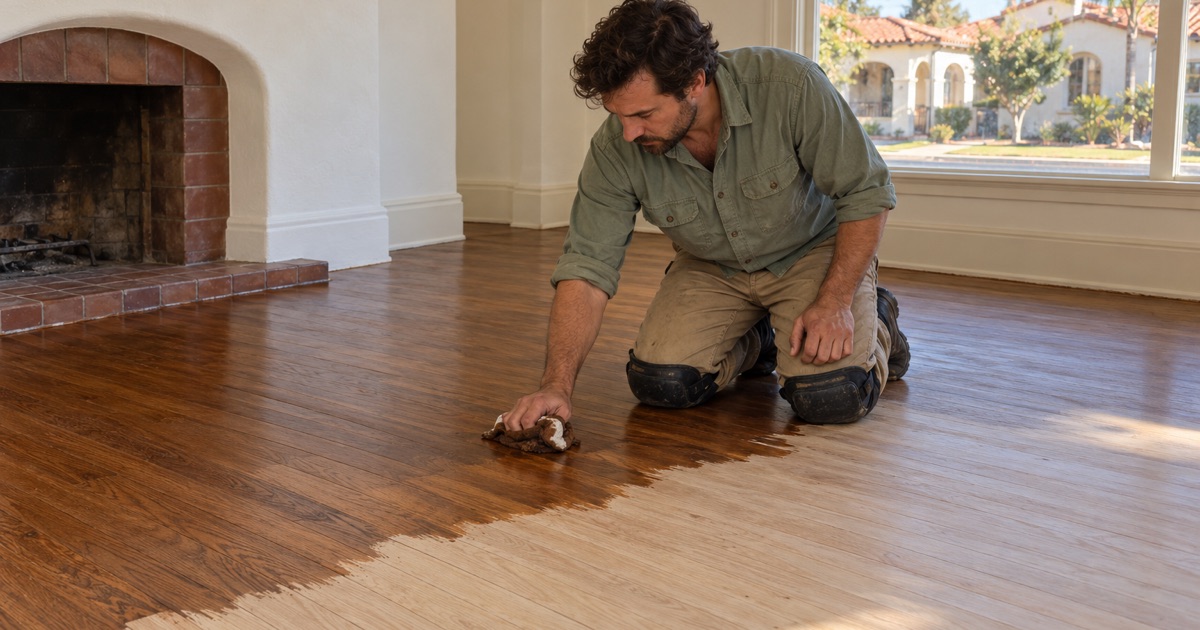
Long Beach entered the 1920s as a seaside resort town with a population of 55,600. Then oil was discovered at Signal Hill in 1921, and demand for housing surged so quickly that the population swelled to 125,000 by 1923. The city’s 2009 Historic Context Statement, prepared for its Office of Historic Preservation, files this decade under the theme Oil Boom Town and records that single-family homes were built by the hundreds each year between 1920 and 1930.
By the end of the 1920s Long Beach had grown to 145,000 residents, and the statement counts a total of 23 tracts consisting of 1,737 lots. The fastest-growing areas it names include Belmont Shore, Bixby Knolls, Country Club Estates, Los Cerritos and Naples. Houses ranged from the mansions of Country Club Estates to the modest bungalows of Brenner Place. Craftsman homes kept going up, but a craze for revival styles, particularly Spanish Colonial Revival, overshadowed them.
For a floor contractor, that decade explains a lot about what we find. Many houses put up that fast have now been lived in for close to a century, through carpet fashions, kitchen remodels and a long string of owners. The statement notes that Period Revival homes came with the latest heat, electricity, appliances and plumbing of their day, but it names no floor material for the houses, so we never assume what species is down there until we have seen it.
The census gives a sense of scale. Of Long Beach’s 181,477 housing units, 34,819, or 19.2 percent, were built in 1939 or earlier, and 52.3 percent predate 1960. Not every one of those prewar units is a 1920s house, since the count also takes in apartments and homes from other decades, but the share is large enough that we plan every estimate here around the chance of an old floor under whatever is showing.
The boom was not only houses. In spring 1922 more than 300 realtors met in Long Beach to endorse the own-your-own marketing campaign, and the 1928 Villa Riviera was built as an own-your-own apartment cooperative. When we work in a co-op or condominium unit today, we read the association’s alteration paperwork, underlayment requirements and work-hour rules before any floor comes up, and we choose acoustic underlayment with the neighbor below in mind.
Looking for wood-flooring closer to La Mirada? See La Mirada Wood-Flooring.
California Heights, the Bixby Tracts and North Long Beach
California Heights and Chateau Thierry
In 1921 the Jotham Bixby Company subdivided a portion of Rancho Los Cerritos and opened the California Heights tract, where lots came with oil rights. The early houses were built by the Bixby Company itself and consisted of small Spanish Colonial Revival bungalows, and later homes in the tract added Tudor Revival and Craftsman designs. By the end of the decade 250 families had moved into the area.
That mix is worth knowing before a refinish. A Tudor Revival or Craftsman house in the tract may have gone up a few years after the Bixby bungalows near it, so we never assume two neighboring houses share a species, a board width or a finish history. We measure and inspect each one on its own terms.
The statement pairs California Heights with the Chateau Thierry tract, which had opened in 1919 with lots of 70 by 180 feet, and in 1927 the two tracts formed an improvement association. For floor work, a small bungalow changes the job more than its style label suggests. Rooms are compact, and when a living room, dining room and hall share one continuous floor, a repair or refinish has to read evenly across all three.
North Long Beach’s Modest 1920s Homes
In North Long Beach, tracts such as Fair Acres, a 101-acre subdivision near Market Street and Lime Avenue, along with Spaulding Park, Zane Gardens and the Cherry Boulevard Tract, largely consisted of modest single-family homes in the Craftsman and Spanish Colonial Revival styles. These were working houses rather than showpieces. Nearly a hundred years on, a house like this can carry the evidence of every owner’s budget: a room carpeted in one decade, a hallway patched in another, a kitchen tiled over somewhere along the way.
Across Long Beach, 75.9 percent of owner households live in a detached house. In a home like that we can stage the work room by room behind dust containment, so a family keeps living in one end of the house while the other end is sanded and cured. We hand over a written cure schedule so everyone knows when each room can take foot traffic and furniture again.
Floors After a Century of Wear
What Carpet Hides
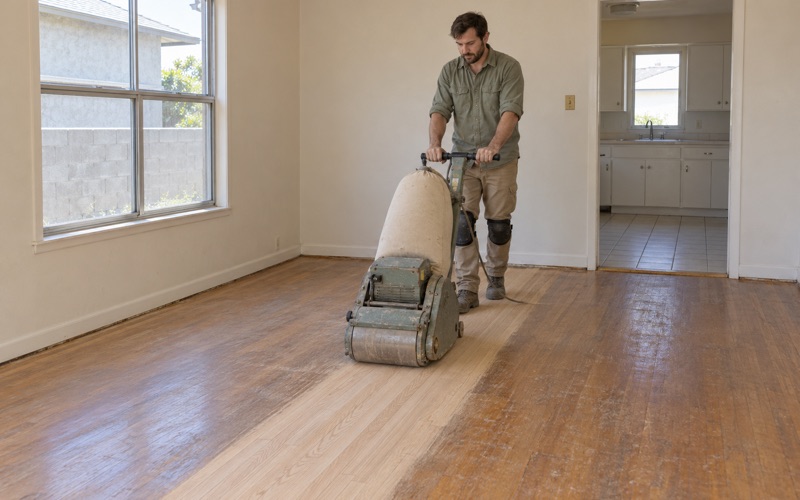
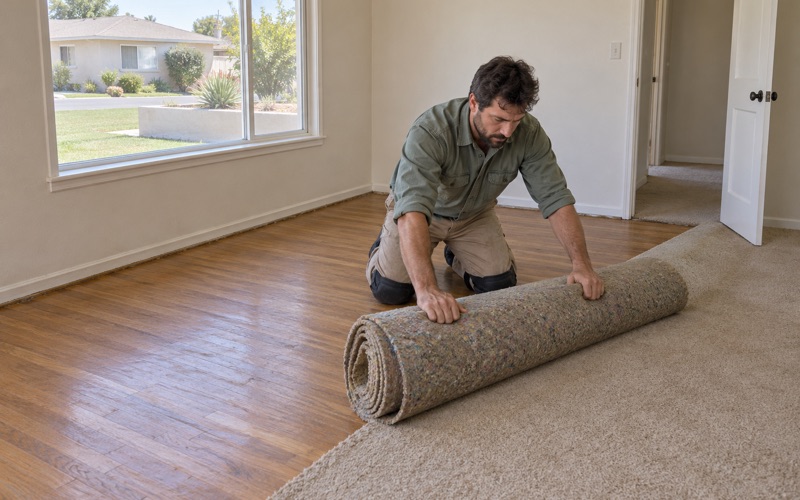
When an older Long Beach house has wall-to-wall carpet, the first job is finding out what it has been covering. Before any sanding, we lift the pad, pull every staple and length of carpet tack strip, and fill the holes they leave, because a drum sander run over a missed staple gouges the wood and an open hole shows through the new finish. Only then can we judge whether the boards have enough wood left above the tongue for another full sand.
Wear Patterns We Look For
A century of foot traffic leaves a map. We look for boards cupping or crowning near old kitchens and bathrooms, gaps opening between boards, squeaks where fasteners have loosened, and finish worn to bare wood along the paths people actually walk. Pet urine stains, dark rings under old planters and the orange cast an aged finish can give oak each tell us something about how deep the damage goes.
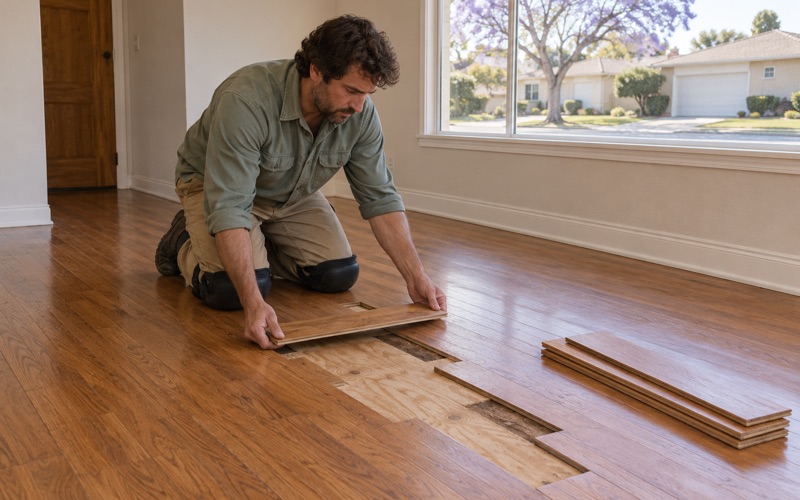
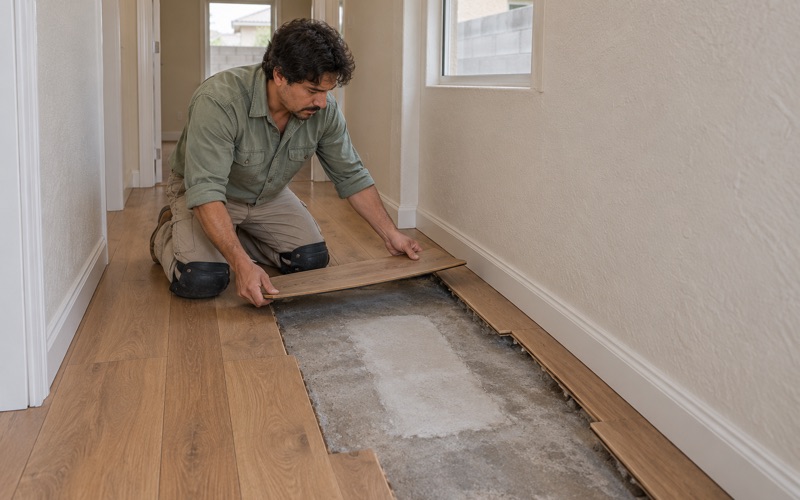
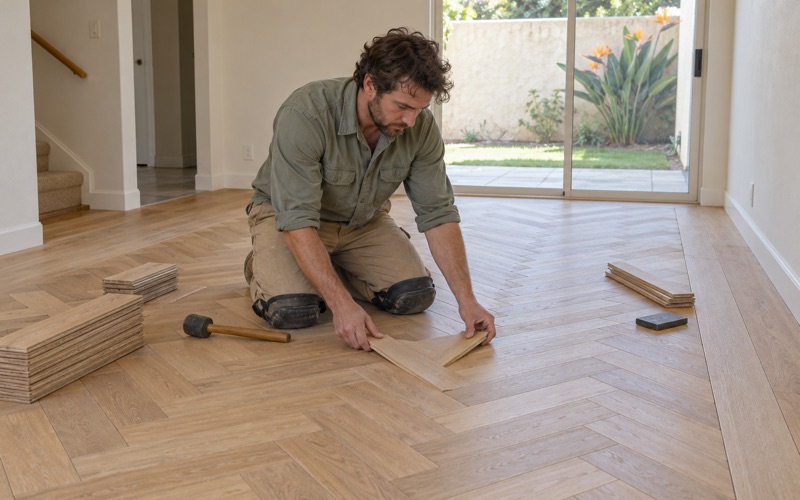
Some of those problems are surface deep and sand out; others go through the board. Deep urine stains, cracked boards and drywood termite damage call for board replacement, and in a floor this old the matching matters. We match discontinued boards by species, width and finish, then weave replacements into the existing courses so a repair does not read as a patch.
Under the Floor
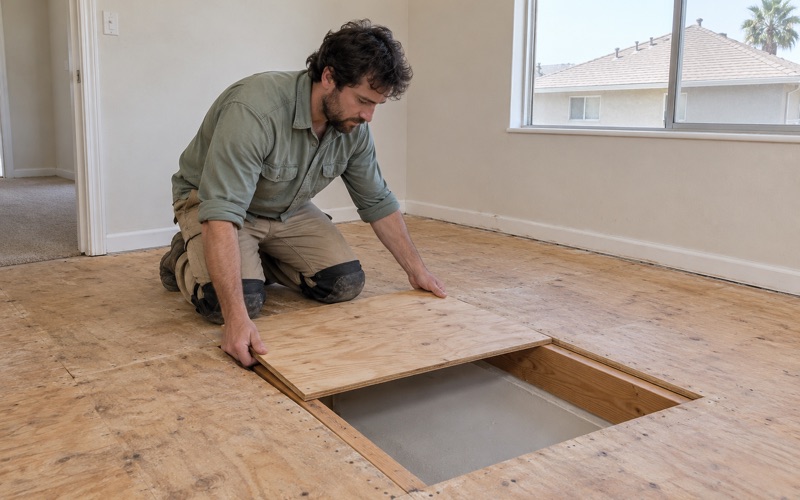
Wear on top can hide trouble underneath. We check the subfloor before pricing a refinish or a new finish floor, looking for soft spots and water-swollen sheathing, because sanding a floor over a failing base only buys a callback. Where a slab leak or repipe has sent a plumber through the floor, we plan the access hole before any board is cut, then dry and patch the wood around the repair.
Moisture readings matter even in a floor that has sat dry for decades. We compare moisture content from room to room with a wood moisture meter, because a reading that jumps near a bathroom or exterior door usually points to a leak that sanding would only hide. Those numbers go on the estimate, so the reason behind a repair recommendation is on paper.
When water is the cause, we trace it back to its source and document the damage with photos and moisture readings an insurance adjuster can use. Replacing boards over a leak that is still running just repeats the loss.
Refinishing a Revival-Era Home With Care
Lead and Asbestos Come First
Every house from the 1920s was built before 1978, so we follow lead-safe work practices from setup to cleanup, in line with the EPA Renovation, Repair and Painting rule. Baseboards, shoe molding and door casings in a house this old can carry many coats of paint, and work next to them needs the same care as the floor itself.
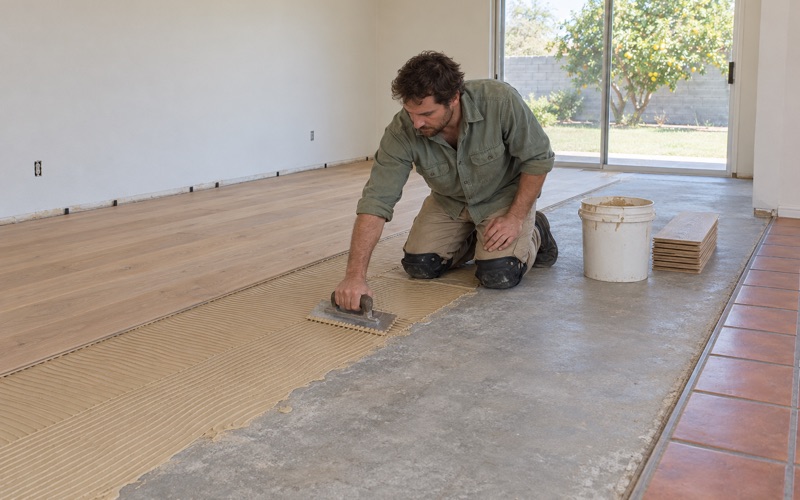
Kitchens and back rooms updated in later decades sometimes hold 9x9 floor tile set in black mastic. We treat both as a possible asbestos question, and that question gets answered before anything is sanded, scraped or pulled up. Where an addition or later room sits on concrete, we take old glued-down flooring and adhesive off the slab and test the concrete for moisture before anything new goes down.
Sanding and Finish Choices
A floor that has been sanded several times over the decades may have little wood to spare, so we set the grit sequence to take only what the surface needs, and some floors are better served by a screen and recoat than a full sand. We work the field with a drum sander, the perimeter with an edger and the final blend with an orbital sander, using a dustless sanding system so the rest of the house stays livable.
We choose finishes from products legal to apply in the South Coast air basin, where SCAQMD Rule 1113 caps wood coatings at 275 grams per liter of VOC. Within that limit a homeowner can still choose waterborne polyurethane, which stays lighter, oil-modified polyurethane, which ambers with time, or a hardwax oil finish, plus a sheen level that suits a Spanish Colonial Revival room as well as a Craftsman one.
Refinish, Repair or Replace
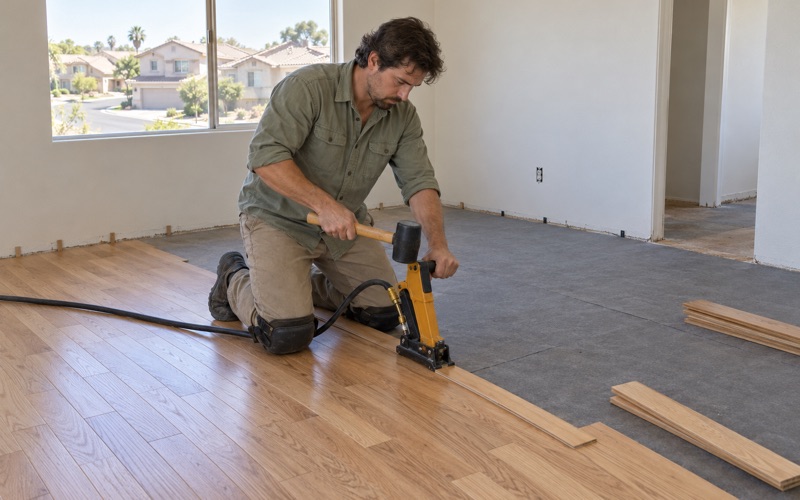
Sometimes a floor has been sanded too thin or damaged too widely to refinish, and a new floor is the better answer. We then compare species by Janka hardness, let the material acclimate until its moisture content suits the house, and install to NWFA installation guidelines. Stairs are priced per tread and riser rather than folded into a square-foot number, which keeps the estimate honest wherever a house has them.
The goal in a house like this is a floor that looks cared for rather than new. Clean edges along old trim, repairs that match their neighbors and a finish suited to the period are what let a room built in the oil boom keep its character after we leave.
- 20+ Years of Floor Work
- Written, Itemized Estimates
- Moisture Readings Recorded