Westminster Wood Flooring brings more than 20 years of work to wood flooring in La Palma, and many of the calls we get here start the same way: someone has just bought a house and wants to know what the floors need before the furniture arrives. That window between closing and move-in is short, and it is the easiest time to do floor work, because the rooms are empty and nobody has to live around the dust. We plan a lot of our work in this city around that window.
Our first visit is an assessment, not a sales pitch. We read moisture in the wood and in any concrete the floor sits over, check the subfloor for soft spots and swollen sheathing, and write every reading down so the new owner has a record of the floors as they were bought. Then we write an itemized estimate so the buyer can see which items are urgent and which can wait.
Buying a First Home in La Palma and the County Programs Behind It
La Palma’s adopted 2021-2029 Housing Element, approved by the City Council on October 5, 2021, lists two homeownership programs aimed at first-time buyers. Neither one is run by the city itself. Both are county programs, and the city’s job is to make sure buyers hear about them.
Down Payment Assistance
The first is a Mortgage Assistance Program for low-income first-time homebuyers, administered by the Affordable Housing Clearinghouse under contract with Orange County Housing & Community Services. It provides down payment assistance targeted at households with incomes at or below 80 percent of the area median income. The element describes it as help with the purchase; it says nothing about repairs or finishes, so we treat floor work as its own budget.
The Mortgage Credit Certificate
The second is the Mortgage Credit Certificate, a federal income tax credit program administered by the County of Orange and originally created by Congress through the Tax Reform Act of 1986. For a qualifying first-time buyer of an owner-occupied home, it reduces federal income taxes by 15 percent of the annual interest paid on the mortgage. The city’s own page adds that the credit lets a buyer qualify for a loan more easily by increasing their effective income.
What the City Does
La Palma’s part in both programs is publicity and referral. For each one, the element sets the same objective: publicize the availability of Orange County mortgage assistance programs by providing links between the County’s and City’s websites. Eligibility, income limits and timing are questions for the county administrators, not for the city and not for us.
Why does a flooring company care? Because the buyers these programs are written for are the buyers most likely to be working to a tight budget after closing, and floor work is often the first large spend in the house. Knowing that shapes how we scope a job: what has to happen before move-in, and what can wait a year.
Looking for wood-flooring closer to Buena Park? See Wood-Flooring in Buena Park.
What a First-Time Buyer Finds Underfoot
The houses these buyers are shopping for are mostly from one era. According to 2024 American Community Survey estimates, 75.6 percent of La Palma’s housing units were built between 1960 and 1979, and 90.1 percent of owner households live in detached houses. The housing element itself calls the stock “aging but of high quality,” which matches what we see: well-built houses whose floors have been through four or five decades of family life.
Under the Carpet
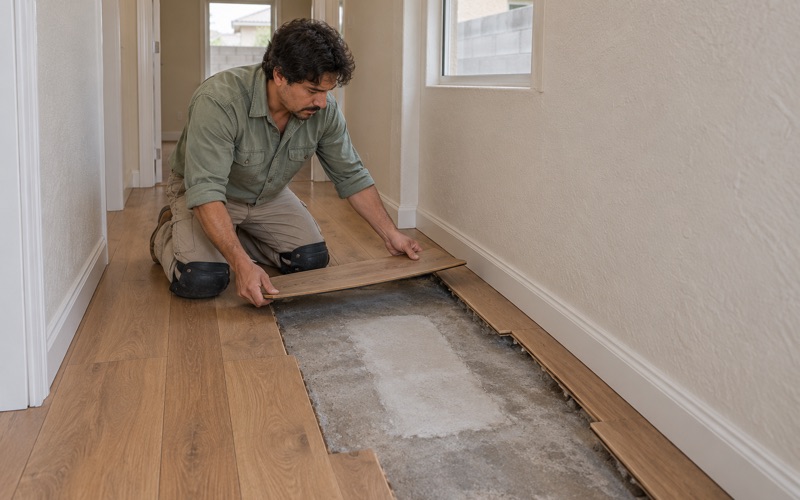
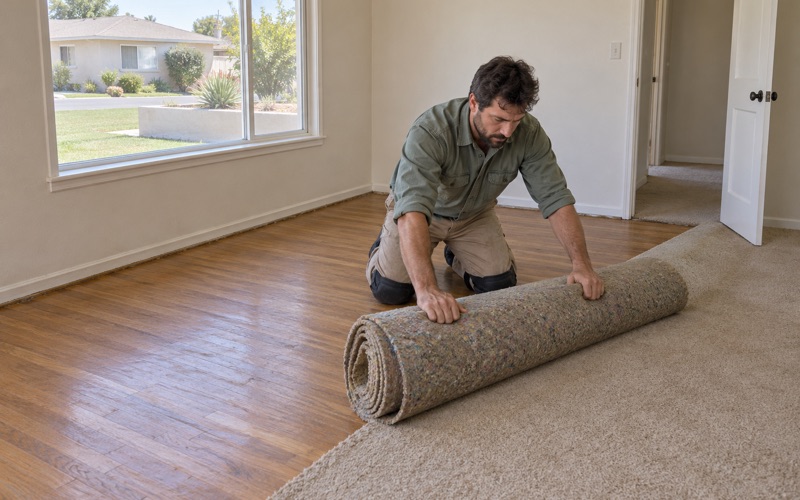
When a house of this age comes with carpet, nobody can say what sits under it until it comes up. Sometimes it is wood, sometimes bare concrete, sometimes an earlier layer of sheet goods or tile. We lift the carpet, pad, staples and tack strip, fill the holes they leave, and only then decide whether the floor underneath is a refinishing job or a replacement job.
Wood that has been down for decades often shows the familiar signs of age: the orange color change oak takes on under older oil-modified finishes, gaps between boards, squeaks, and pet urine stains that go deeper than the finish. We note each one at the assessment so the estimate reflects the floor that is actually there.
In houses of this age we also look for drywood termite damage and termite frass along baseboards and thresholds before refinishing. Boards that sound hollow or crumble at the edges turn a refinish into a board replacement, and it is better to know that before the sander comes out.
Tile and Mastic From the Era
Floors laid in the 1960s and 1970s can include 9x9 floor tile and black mastic adhesive, both of which can contain asbestos. We treat any old tile or dark adhesive as an asbestos question before anything is sanded, ground or scraped, and we recommend an asbestos survey where the material is suspect. A buyer who learns this at the assessment can plan for it; a buyer who learns it halfway through demolition loses days.
Lead-Safe Work in Pre-1978 Houses
Most houses a first-time buyer tours here predate 1978, the cutoff year for the EPA Renovation, Repair and Painting rule. Sanding near painted baseboards, door casings and stair parts can disturb old lead paint, so we follow lead-safe work practices on these houses: containment, careful removal of trim, and cleanup that does not leave dust in the rooms a new household is about to move into.
Planning Floor Work After Closing
Once the keys change hands, we work backward from the move-in date: when the moving truck is booked, which rooms have to be usable first, and how long each coat of finish needs before furniture can go back on it. Every job comes with a written cure schedule so the household knows exactly when each room can be walked on and furnished.
Sanding in an empty house is simpler, but we still contain dust with a dustless sanding system and sealed doorways, because buyers often have painters, electricians or a plumber working in the next room during the same week. If the household has already moved in, the same containment keeps bedrooms and the kitchen usable while other rooms are being finished.
Refinish, Repair or Replace
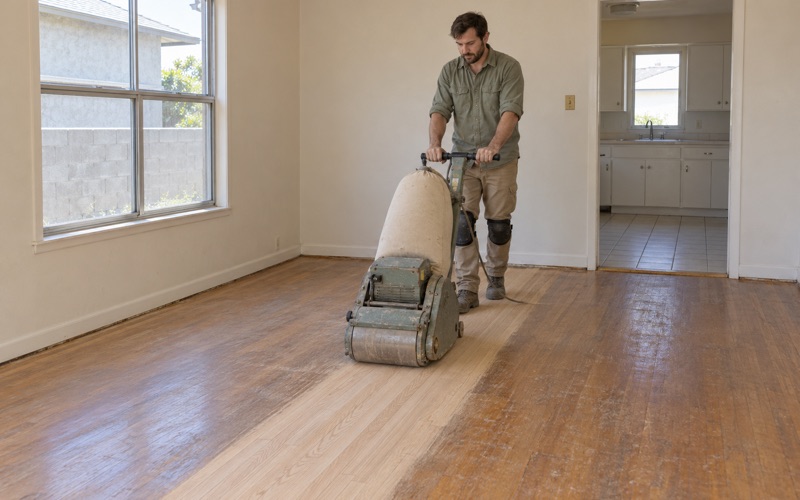
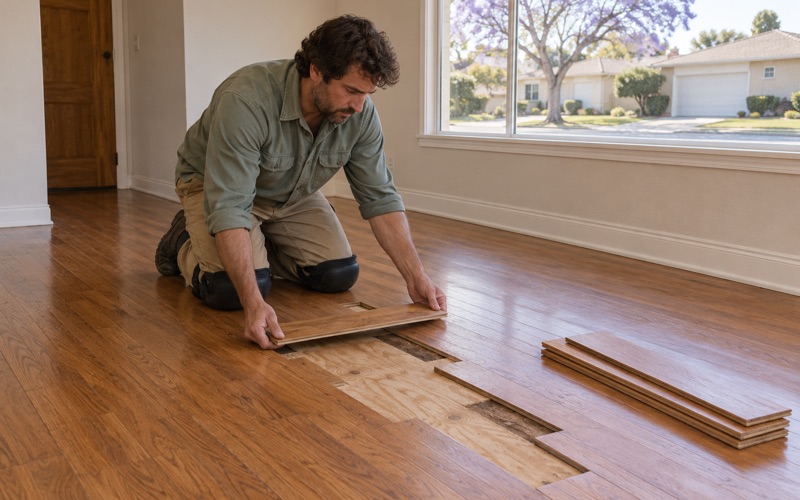
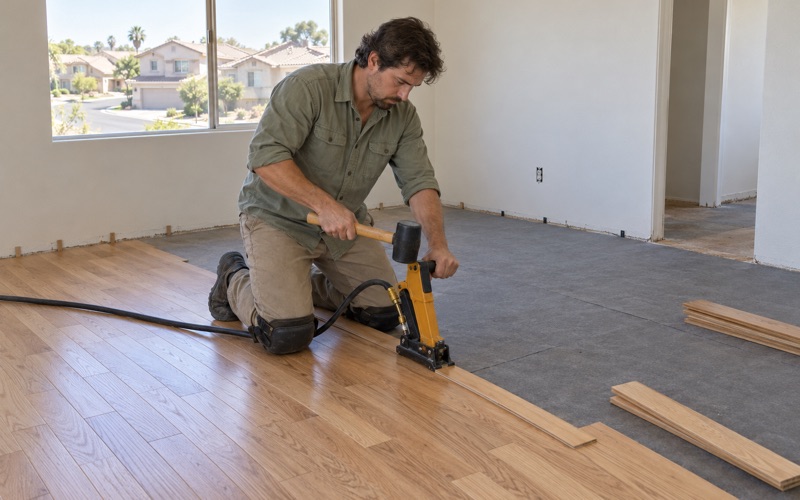
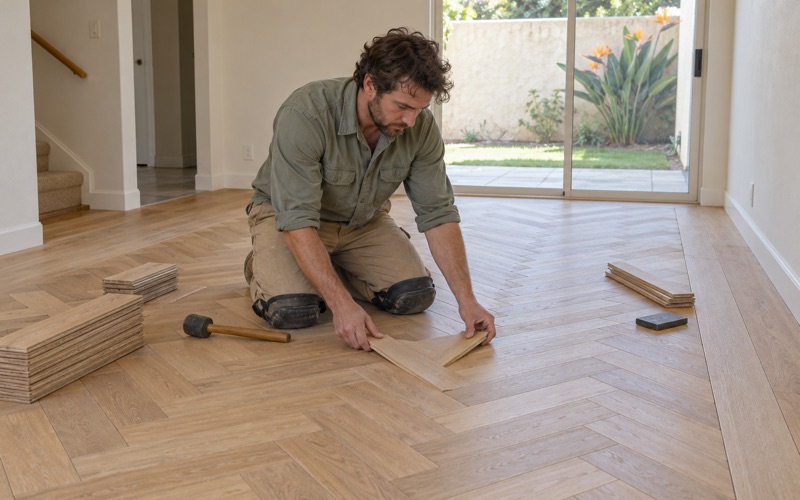
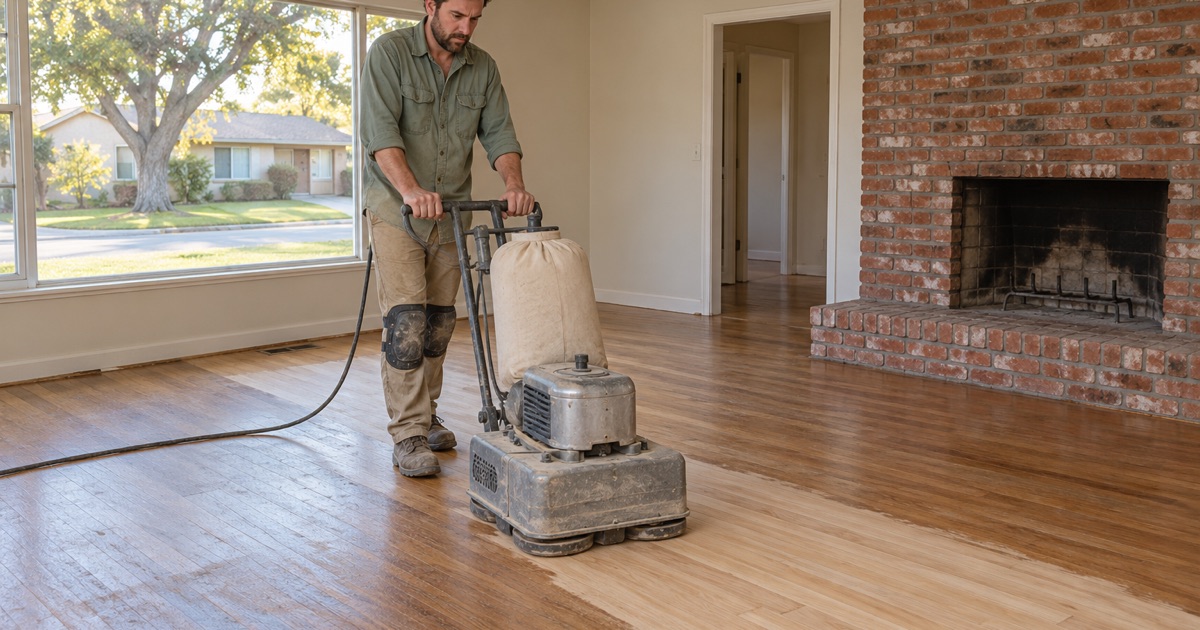
If the wood under the carpet is sound, a full sanding with a drum sander, edger and orbital sander through a proper grit sequence usually brings it back. Where boards are damaged, we match discontinued stock by species, width and finish and weave new boards in so the patch does not read as a patch. Where the floor is past saving or the buyer wants something different, we talk through engineered and solid options, wear layer thickness, and how a harder species on the Janka hardness rating holds up to kids and pets.
If the wood is sound and only the finish is worn, a screen and recoat may be all the house needs before move-in, with a full sanding saved for later. That is often the sensible call for a buyer who would rather put the first year’s money into the roof, plumbing or kitchen.
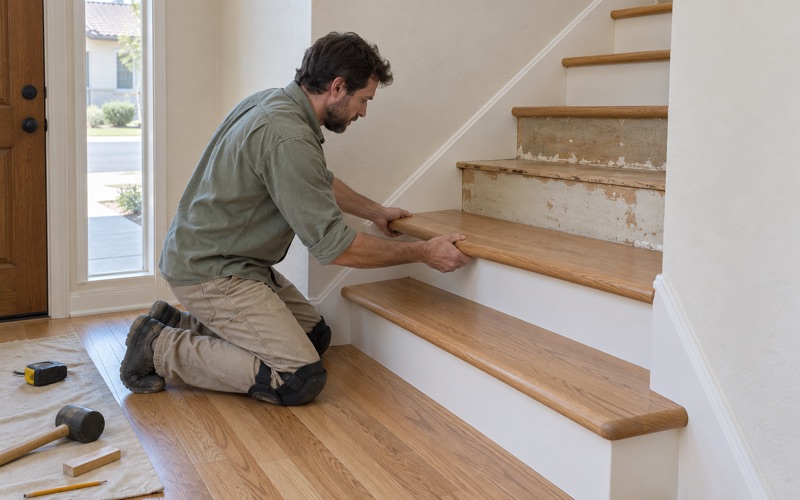
Stairs get their own line. We price each stair tread and stair riser separately, along with nosing and any shoe molding that has to come off, because a staircase takes far more handwork per square foot than an open room.
Moisture Before Anything Is Ordered
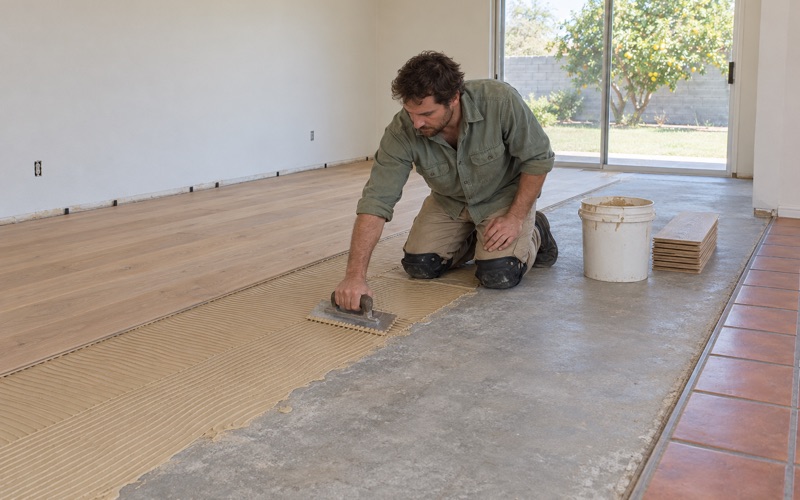
New flooring does not get ordered until we have measured moisture. We check moisture content in existing wood and in the new boards with a wood moisture meter, and where wood will go over concrete we test the concrete with a calcium chloride test or an ASTM F2170 in-situ relative humidity test. The readings go into the job file, and acclimation follows the NWFA installation guidelines rather than a guess.
Finishes That Meet South Coast Air Rules
La Palma sits in the South Coast Air Quality Management District, so every finish we apply has to be legal under SCAQMD Rule 1113 and its 275 g/L VOC limit for wood coatings. Within that limit, a buyer still chooses among waterborne polyurethane, oil-modified polyurethane and hardwax oil, and picks a sheen level. Waterborne finishes usually let a household back into the rooms sooner, which often decides it when the move-in date is fixed.
When a Longtime Owner’s House Changes Hands
The age figures show why floor work here so often lands on a new owner. In the 2024 ACS estimates, only 6.7 percent of La Palma’s owner householders are between 25 and 34 and 19.1 percent are under 45, while 35.3 percent are 65 or older. A first-time buyer here is typically stepping into a house an older generation lived in, along with every floor decision that generation made.
Floors Assessed at Purchase
We are glad to look at floors before a buyer’s contingency period ends, not only after closing. A walk-through with moisture readings, a subfloor check and a note on any suspect tile gives the buyer something concrete to weigh alongside the inspection report. If a seller credit for flooring is on the table, a clear written scope makes that conversation shorter.
What Decades of Living Leave Behind
Houses that have been lived in this long carry a layered history. We find old repairs in mismatched species, floor registers cut in and moved, thresholds built up with a stack of reducer strips, and areas near kitchens and baths where an old leak left its mark. None of that shows under carpet, which is why we check before we price.
Plumbing Work and Water Damage
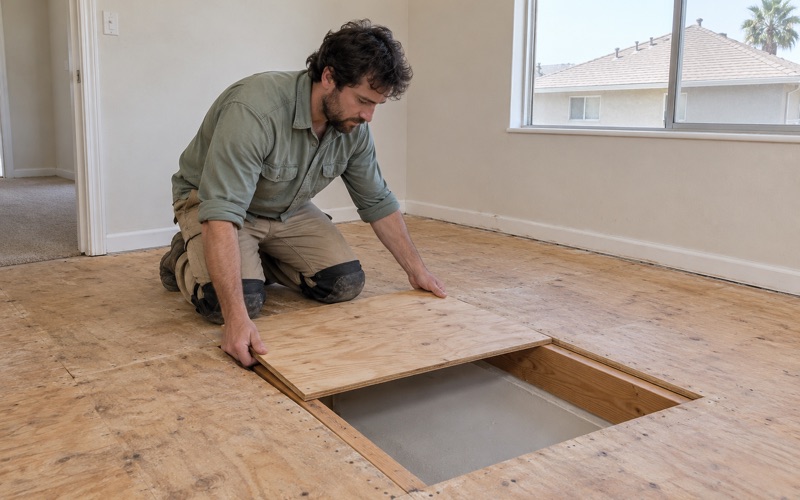
Plumbing work is a common early project in an older house, and it often collides with the floors. When a repipe or leak repair needs access under wood, we plan the plumber’s access hole before any boards are cut, then dry, patch and refinish the area so it blends. If water has already damaged a floor, we trace it to the source and document it with photos and moisture readings an insurance adjuster can use.
A Small, Consistent City
La Palma incorporated on October 26, 1955 as Dairyland and took its current name in 1965 after the dairies moved east. At about 1.8 square miles it is the smallest city in Orange County by area, which means a short drive between any two jobs and a building stock that is remarkably consistent from one street to the next.
For a new owner, that consistency helps: the questions we ask about one house from the 1960s or 1970s are usually the right questions for the next. Whatever the floors under the carpet turn out to be, our aim is for the first project in a first home to finish on schedule, with no surprises the assessment should have caught.
- 20+ Years of Floor Work
- Written, Itemized Estimates
- Moisture Readings Recorded