
Westminster Wood Flooring handles hardwood floor repair in Westminster, CA, serving surrounding cities including Midway City, Garden Grove, Stanton, Fountain Valley and Huntington Beach. In 20+ years of fixing floors, we have cut out and replaced boards damaged by water, pets, termites, dropped pans and old repairs gone wrong, and we still start every repair the same way: by finding out why the floor failed before deciding how to fix it.
A good repair is one nobody can find afterward. That takes boards matched by species, width, thickness and grain, woven into the existing floor rather than butted in as a square patch, and a finish blended to the color and sheen around it. When the original product is no longer made, we track down or mill a match before the first board is cut.
You get a written, itemized estimate that shows the board replacement, any subfloor work and the finishing as separate lines, so you can see where the cost sits. Where the damage points to a moisture problem, the readings go in writing too, because a floor repaired over an unsolved leak simply fails again.
Finding Out Why the Floor Failed
Cupping, Crowning and Buckled Boards
When board edges rise above the centers, the floor is cupping, almost always because moisture is getting into the underside faster than the top. Crowning is the opposite shape and often follows a floor that was sanded flat while it was still cupped. Buckling, where boards lift right off the subfloor, is the extreme case.
We take readings across the floor with a wood moisture meter, compare wet and dry areas, and look for the source, whether that is a leaking line, a missing vapor retarder or a slab that was never tested. Only once the readings settle do we decide whether the boards can be sanded flat or need replacing.
Gaps, Squeaks and Loose Boards
Board gaps that come and go with the seasons are ordinary wood movement and are best left alone. Gaps that stay open all year, or keep widening, usually mean the floor was installed too wet or has lost its fasteners. Squeaks and loose boards come from the same loss of grip, with wood rubbing on nails or the subfloor flexing over a floor joist. We locate each problem area, refasten from below where the joists are reachable or from above with trim-head screws set and filled, and fill only gaps that will not reopen.
Termite Frass, Pet Stains and Impact Damage
Drywood termites leave small pellets of frass near the damage and boards that sound hollow when tapped. Pet urine that has passed the finish leaves dark gray or black stains that sanding rarely removes. Dropped cookware, furniture dragged without pads and old burns leave dents and gouges. Termite damage waits until a pest control company has treated the colony; the other kinds of damage can usually be repaired right away by cutting out and replacing the affected boards.
Board Replacement and Weave-In Repairs
Cutting Out Damaged Boards Cleanly
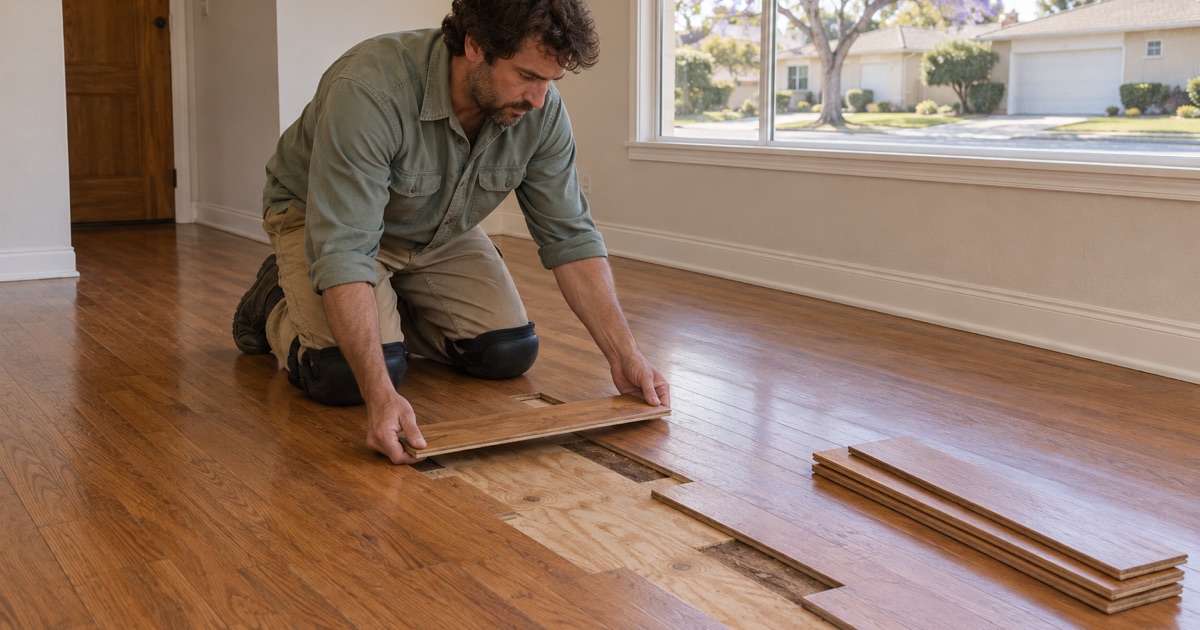
A damaged board is removed by cutting down its center and prying the halves out toward the middle, which protects the tongues and grooves of the boards on either side. The subfloor beneath is checked for damage and cleaned, and any fasteners left behind are pulled or set. That careful removal is what lets a new board slide into place tightly instead of leaving a visible gap or a raised edge.
Weave-In Repair Instead of a Square Patch
Replacing a rectangle of boards leaves straight lines of end joints that the eye picks up immediately. A weave-in repair staggers the replacement boards to different lengths, so their end joints fall at random like the rest of the floor. It takes more cutting and more time, but it is the difference between a repair that disappears and one that reads as a patch from across the room.
Matching Discontinued Flooring
Older floors often use a board width, species or thickness that is no longer sold. We match the original by measuring the profile, identifying the species and grade, and sourcing salvaged boards or having new stock milled to fit. When nothing close enough exists, we sometimes take original boards from inside a closet or under a built-in cabinet for the visible repair and put the new stock where no one will see it.
Repairs Tied to Water and the Subfloor
Boards Damaged by an Appliance or Pipe Leak
Water from a dishwasher, refrigerator line, water heater or supply pipe travels under a floor before it shows on top. We trace it to the source, measure how far the moisture spread and document the damage with photos and readings an insurance adjuster can use. Boards that have swollen, stained or delaminated are removed, the area is dried and checked again, and only then are replacement boards woven in.
Slab Leak Access and Patching
When a plumber has to reach a line under a concrete slab, the wood above has to open. We plan the access opening with the plumber so it is no bigger than it needs to be, remove the boards carefully enough to reuse any that are undamaged, and let the slab dry after the pipe is fixed. The opening is then filled with matching boards and blended into the surrounding floor.
Soft Spots and Subfloor Damage Below the Boards
If a floor gives underfoot, the problem is usually not the hardwood but the plywood subfloor beneath it, weakened by a long, slow leak. We open the floor, cut back the damaged sheathing to sound material, install new plywood fastened to the joists and then reinstall the finish boards. Repairing the surface alone over a soft subfloor leaves a spot that keeps flexing and loosening the boards above it.
Finishing the Repair So It Blends
Spot Finishing Against Recoating the Room
A small repair can be sanded and finished by itself, feathered into the surrounding boards. The new finish will still look slightly different from a finish that has aged for years, so for the closest match we often recommend a screen and recoat of the whole room once the repair is done. We explain both options on the estimate so you can choose.
Matching Stain Color and Sheen
New wood starts paler than boards that have been in the light for years, and red oak in particular darkens toward orange under older finishes. We test stain on offcuts and on the repaired boards themselves until the color sits with the rest of the floor, then match the sheen of the topcoat. Color and sheen together are what make a repair disappear.
Stair Tread and Nosing Repairs
Stairs take the hardest wear in most homes, and a cracked tread or a worn, rounded nosing is both a looks problem and a safety one. We refasten loose treads, replace cracked ones and rebuild worn nosings, pricing the work per tread and riser. Each repaired step is stained and finished to match the stairs around it.
- 20+ Years of Floor Work
- Written, Itemized Estimates
- Moisture Readings Recorded