Westminster Wood Flooring has handled wood-flooring in Fullerton for more than 20 years, and many of the older houses we work on here sit under preservation rules that change how a floor job should be planned. We refinish, repair, match and install hardwood, starting every estimate with what the house already has rather than what a catalog offers. In a home under a preservation contract or inside a protected district, that approach is less a preference than a practical necessity.
The reason is simple. Fullerton’s preservation program is built around a house’s exterior and its building systems, while the finish floors inside stay the owner’s responsibility and the owner’s expense. Our job is to keep those floors sound on a schedule that fits the rest of the preservation work, without creating problems the other trades then have to undo.
Before any sanding starts, we measure moisture in the wood, check the subfloor, and write down what we find. On any house built before 1978, we follow lead-safe work practices from the first day.
Fullerton’s Mills Act Program and What It Covers
On April 21, 2020, the Fullerton City Council voted unanimously to adopt the Mills Act, the state program enabled by Government Code sections 50280 through 50290. Under a contract, the owner agrees to preserve, maintain and rehabilitate the historic property, and the Orange County Assessor reassesses it to a historical property value. The city’s guidelines put firm limits on how fast the program grows.
Ten Contracts a Year, First Come, First Served
The city may process no more than ten Mills Act contracts in a calendar year, and applications are taken first come, first served, due no later than August 1. The application fee is $1,520, followed by an $85 annual fee once a contract is in place. Contracts are recorded by December 31, so an owner who misses the August deadline or lands eleventh in line waits for the next year.
The guidelines also require the City Council to adopt a resolution reauthorizing the program once the total number of approved contracts reaches 50. For an owner, the practical lesson is that a slot is not guaranteed in any given year, so floor work should not wait on one.
Eligibility has its own gates. The property must be privately owned, residential, subject to property taxation and assessed at less than $800,000, and a house in a Residential Preservation Zone is judged case by case on its age and its historic and architectural integrity.
Exterior and Building Systems, Not Interior Finishes
The guidelines are blunt: the Mills Act is not intended to be a subsidy for those seeking to remodel their property. Appropriate work includes seismic retrofit, re-roofing, plumbing, electrical and mechanical repair, window repair, siding repair and repainting. All work must relate to the exterior or building systems, and cosmetic improvements to the interior, such as kitchen or bathroom renovations, are not eligible work items.
Floors are not named in the guidelines either way, and we do not guess on an owner’s behalf. What we can say is that any refinishing we do is paid for by the owner and scheduled as its own job, separate from the contract’s work plan. If an owner wants a ruling on a specific item, the program’s guidelines come from the city’s Community and Economic Development Department, Planning Division, at 303 West Commonwealth Avenue, and that is the place to ask.
Looking for wood-flooring closer to Long Beach? See Wood-Flooring Services in Long Beach.
Interior Inspections in a Contract House
Fullerton’s pre-approval inspection includes both the exterior and the interior of the property, and contract properties are inspected once every five years after that, again inside and out. The guidelines do not say what an inspector looks at indoors, and the program FAQ says contracts are enforced by evaluating everything visible from the public right-of-way. We plan around the fact that someone from the city will walk through the house, not around a guess about what they will write down.
Timing Floor Work Against the Inspection Calendar
An interior visit is a poor day to have a living room stripped to bare wood with the furniture stacked in the dining room. When an owner tells us an inspection date, we schedule sanding and finish coats so the rooms are cured and back in use before it arrives. Every job carries a written cure schedule that says when each room can be walked on in socks, when furniture can return, and when rugs can go down.
Contract Trades and the Floor Underneath Them
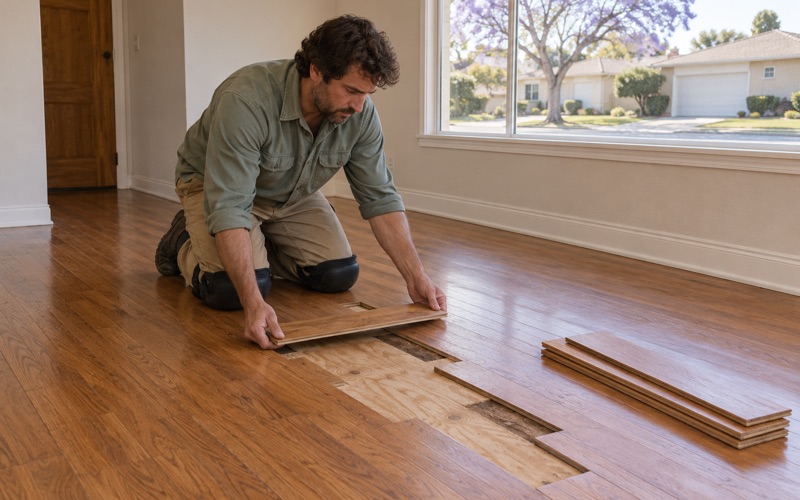
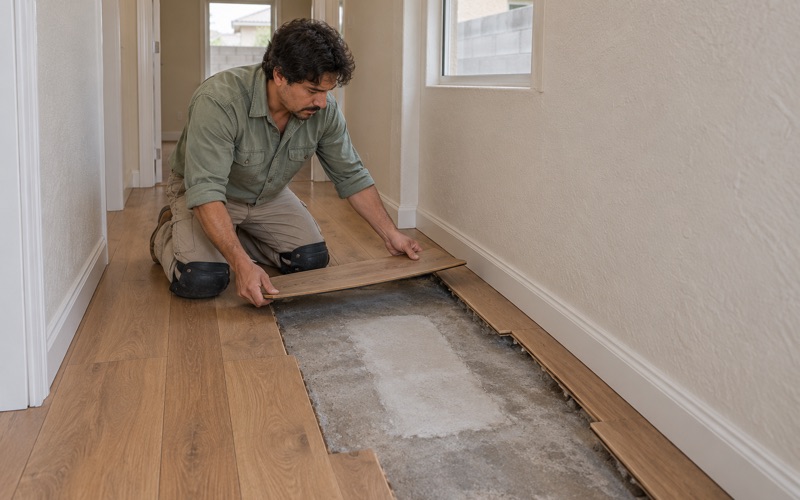
Much of the eligible work touches floors anyway. A repipe or a plumbing repair can mean an access hole through boards, and a seismic retrofit or electrical upgrade can send crews through rooms with finished wood. We plan the plumber’s opening before a board is cut, then dry, patch and weave in matching boards so the repair does not read as a patch.
Where the original boards are no longer made, we match replacements by species, width and finish before the repair starts. Moisture content in both is measured and recorded, so the patch and the field around it settle together instead of cupping or leaving board gaps a season later. When a leak is the reason the floor came up, we trace it to its source and document the damage with photos and readings an insurance adjuster can use.
Keeping Records the House Can Carry
We leave every contract-house owner with the moisture readings, subfloor notes and a list of products applied, all dated. It is our record, not a program document, but it gives the owner a clear record of when the floors were last worked and what went on them. That record also helps the next contractor and any future buyer.
Preservation Zones Like College Park
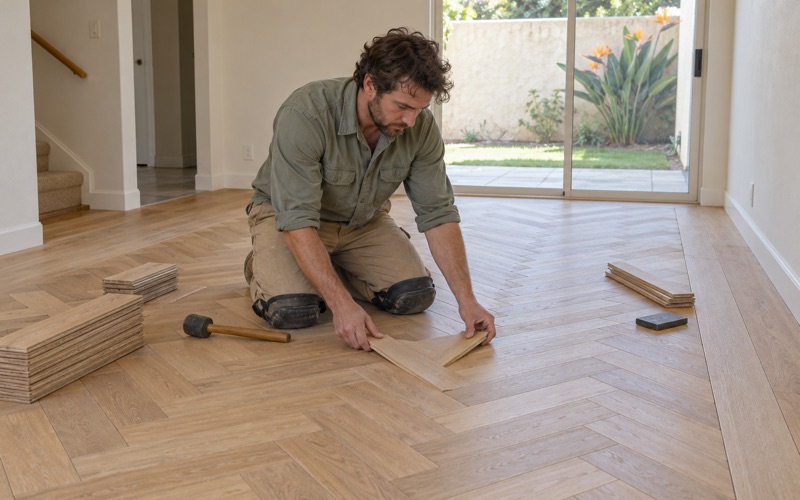
Fullerton has 16 residential areas designated as historic districts, and over the last 25 years ten of them have been given special designation by the city as Residential Preservation Zones. Jacaranda/Malvern and East Whiting/Stanford are among them. Whether or not a zone house ever holds a contract, we approach its floors the same way: repair first, and replacement only where boards are past saving.
A Twelve-Block District of 1920s Bungalows
College Park is a city-recognized historic district, a twelve-block area that was part of the original townsite but was not platted for residential lots until 1922. Its houses were often built from pattern books, modest in scale and design, with the California bungalow as the prevailing style and a scattering of Spanish Colonial Revival and Cottage styles. Owners there requested and obtained an R-2P residential preservation zone in 1979, which keeps new construction compatible with the traditional architecture and streetscape.
What a Century-Old Floor Asks For
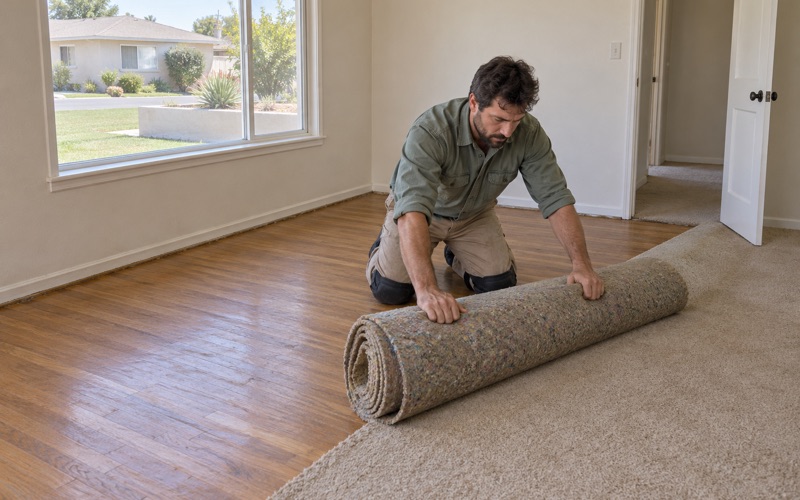
A house from the 1920s has often been through several owners, several finishes and at least one round of carpet. We never assume what species is underneath until we have pulled a register or lifted a corner, and we do not promise a color before we have sanded a test patch. When carpet comes up, we lift the pad, staples and tack strip and fill the holes before sanding, so the wood refinishes clean.
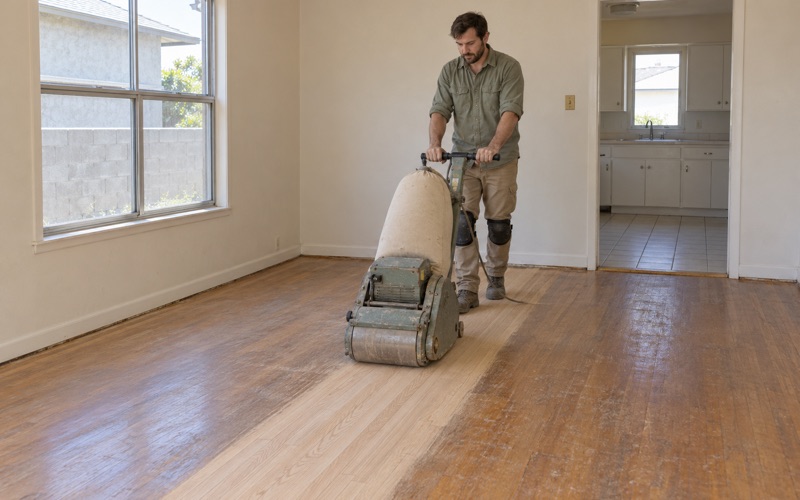
Old finishes and old nails also mean slower sanding. Worn boards may have little wood left above the tongue, so we choose the grit sequence and the number of passes to keep what remains, and sometimes a screen and recoat is the right call instead of a full sand. Where the floor turns out to be oak, an aging oil-based finish has often shifted it toward orange. Sanding to bare wood and finishing with a clear waterborne coat is one way to bring back a lighter tone.
Checks Before Any Price
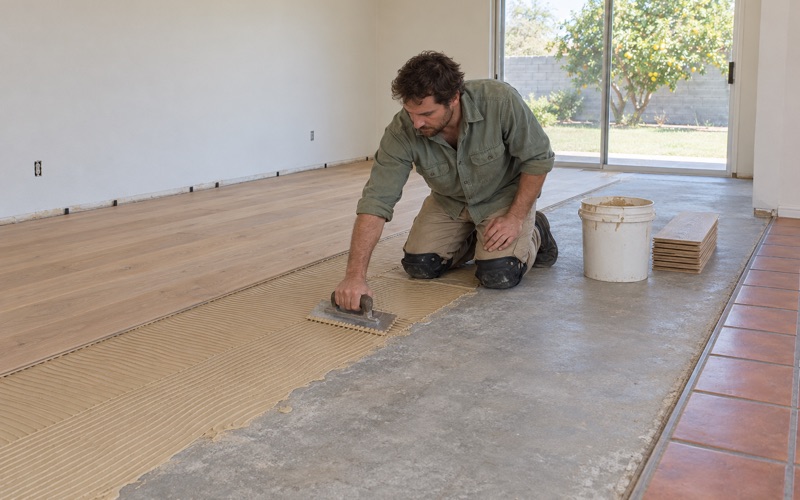
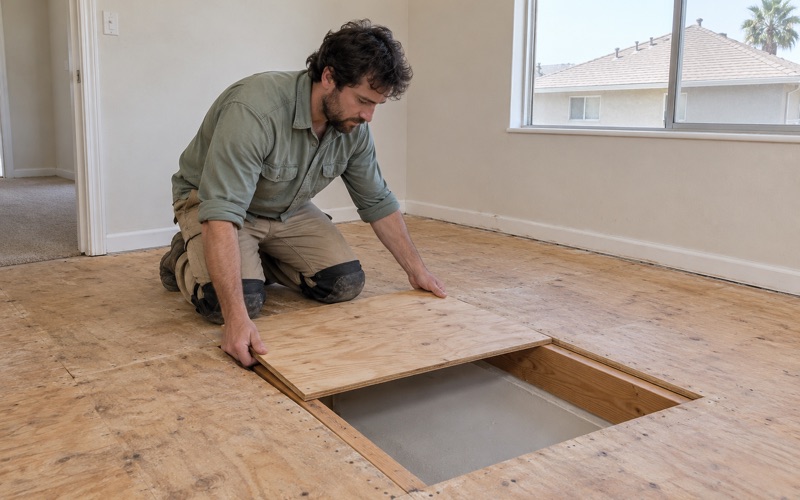
Before we price a finish floor in an older Fullerton house, we check the subfloor for soft spots and water-swollen sheathing. We read moisture in the boards with a wood moisture meter, test concrete wherever a room sits on it, and write every reading down. Acclimation of new boards follows NWFA installation guidelines, so a weave-in or new room matches the moisture content of the floor it joins.
Planning Floor Upkeep Outside the Contract
A contract house carries two budgets: the eligible exterior and systems work the agreement describes, and everything else the owner keeps up on their own. Floors fall on the second list in practice, because the contract’s eligible work leaves interior finishes out. We help owners sequence the two so the floor work lands after the messy trades and before the next inspection.
Why the Order of Trades Matters
Re-roofing, plumbing and electrical work bring ladders, carts and debris through the house. Refinishing first and letting those crews walk on fresh coats wastes the money. Our itemized written estimate separates floor work from anything the contract covers, so an owner can see what they are paying for out of pocket and schedule it in the right year.
A cancelled contract carries a penalty of 12.5 percent of fair market value, so a contract is a long commitment. Laying out the whole sequence of work at the start, floors included, is worth the planning time.
Lead, Tile and Mastic in Older Houses
Fullerton has 2,379 housing units built in 1939 or earlier, and 71.3 percent of its units were built before 1980. Any house built before 1978 gets EPA Renovation, Repair and Painting lead-safe practices from us, with containment set before a sander starts. Old floor tile and black mastic, including 9x9 tile, are treated as a possible asbestos question, and nothing is scraped or sanded until that question is answered.
Finishes for an Occupied House
When a family lives in the house through the work, the finish has to suit that. We choose among waterborne polyurethane, oil-modified polyurethane and hardwax oil products that are legal to apply in the South Coast air basin under the SCAQMD Rule 1113 limit of 275 g/L for wood coatings. Dust containment and a dustless sanding system keep the rest of the house usable while one room is under way.
Sheen level matters too in a period house. A lower sheen hides more of the everyday wear a lived-in floor collects, and a hardwax oil can be spot-repaired without sanding the whole room.
- 20+ Years of Floor Work
- Written, Itemized Estimates
- Moisture Readings Recorded