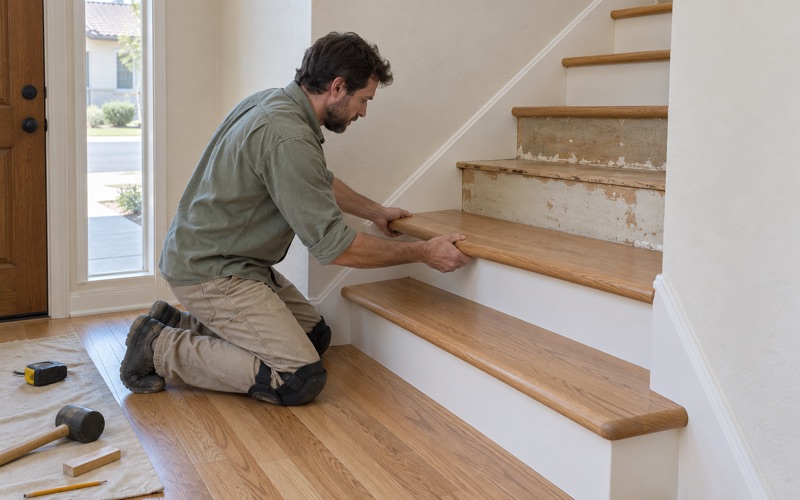
Westminster Wood Flooring has done wood-flooring in Costa Mesa for more than 20 years, and much of that work happens in homes that someone rents rather than owns. We install, sand, refinish and repair hardwood and engineered floors, and we write every estimate so the scope of work states exactly what will be done to the floor. That precision matters more here than in most cities we serve.
Before a board is ordered, we take moisture readings in the wood and the substrate and write them down. Before a finish floor is priced, we check the subfloor for soft spots and swollen sheathing. Those two habits keep a job predictable, which is what a landlord with a tenant in the unit, or a family living through the work, needs most.
The sections below cover how the city reads building permits on rental property, what state law says about cosmetic work, how we run a floor job around people who stay put, and what the age of local housing means for sanding and finishing. None of it is legal guidance; it is the practical side of getting a floor done in a home that stays occupied.
Costa Mesa’s Tenant Protections and Building Permits
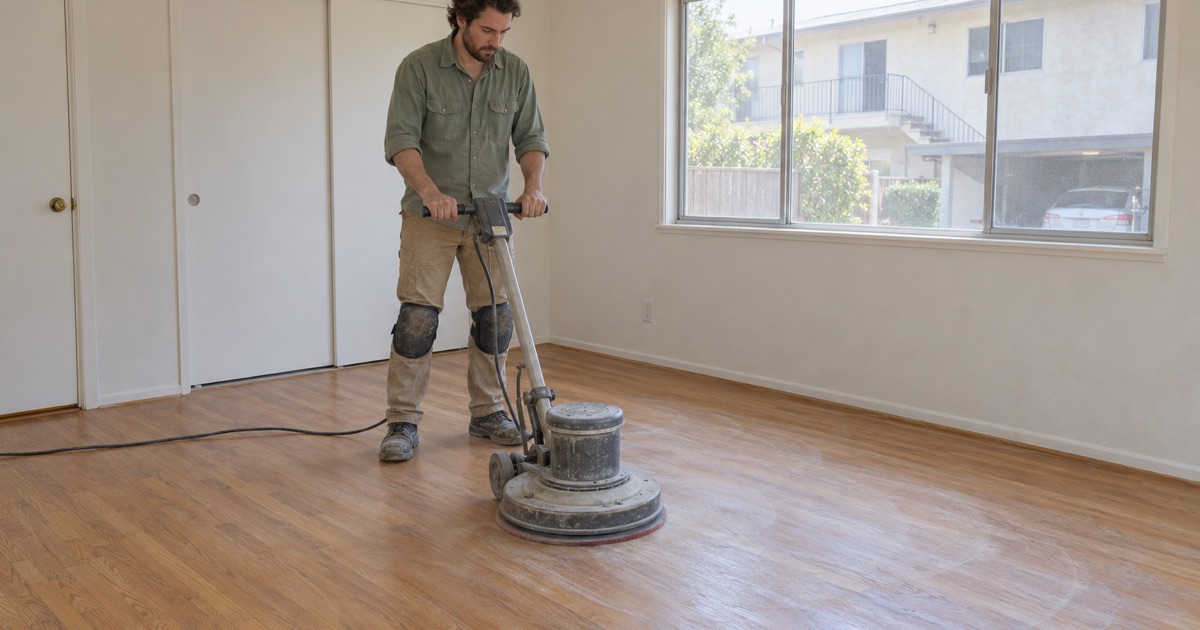
The City of Costa Mesa’s Urgency Ordinance No. 2023-04 added Just Cause residential tenant protections to Title 9 of the municipal code. The state’s CEQAnet record shows the city’s Notice of Exemption for the ordinance was received on December 5, 2023. The city also created three full-time staff positions to implement, monitor and enforce the ordinance and to conduct outreach to landlords.
Permits Now Ask About Evictions
According to the city’s 2024 Annual Report, staff changed the permitting process so that an applicant for a building permit must inform staff when a tenant eviction will occur. When staff learn of a potential eviction, they evaluate the permit’s scope of work to decide which tenant protection process applies. A similar review runs when a tenant who is being evicted notifies the city.
For an owner planning work on a rented unit, the scope of work is no longer just a contractor’s document. We write ours as itemized line items, from removal and subfloor repair through sanding and each finish coat, so the paper describes the floor work accurately and nothing is inflated or left vague.
What the 2024 Numbers Show
For the period covered by the 2024 report, the city received no-fault eviction notices affecting 31 households. Twenty notices were authorized, resulting in lawful evictions, and eleven were denied, reversing those evictions and allowing the households to remain in their homes. Those are the city’s own figures, reported to council in April 2025.
The practical point for a flooring project is that the city reads scope and does say no. Where a project involves an eviction, the scope gets a close look, which is one reason we plan most rental floor work around the tenant rather than around a vacancy.
Looking for wood-flooring closer to Orange? See Orange Wood-Flooring.
Cosmetic Work, Remodels and Tenants Who Stay
California’s Tenant Protection Act draws a line that matters to any rental floor project. Civil Code 1946.2(b)(2)(D)(iii) states that “cosmetic improvements alone, including painting, decorating, and minor repairs, or other work that can be performed safely without having the residential real property vacated, do not qualify as substantial remodel.” Where a particular floor job falls under that language is a question for the owner, the city’s tenant protection staff and the owner’s own counsel, not for a flooring crew.
What we can do is describe the work honestly. A screen and recoat, a board replacement or a sand-and-refinish of one room is work we routinely do with people living in the home, and when a job will run that way, the estimate says so.
Keeping a Household in Place
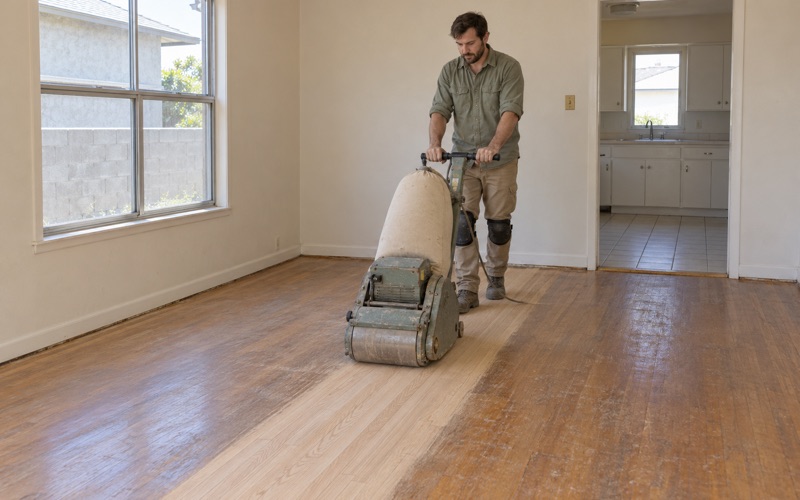
Occupied-unit work comes down to sequencing. We work room by room where the layout allows, seal doorways with dust containment, and connect a dustless sanding system to the drum sander and edger so fine dust stays out of bedrooms and kitchens. Furniture moves into rooms that are already finished or not yet started.
We also plan around the rooms a household cannot do without. Kitchens and the path to the bathroom are scheduled to be out of use for as short a time as the layout allows, and stairs can be finished in alternating treads when they are the only way up.
The finish is where a household loses the most use of a room, so we hand over a written cure schedule before work begins. It says when each room can take socks, when it can take shoes, and when furniture and rugs can go back. Waterborne polyurethane generally returns a room to use sooner than an oil-modified finish, and we explain that trade-off in plain terms.
Every finish we apply is chosen from products legal under SCAQMD Rule 1113, which holds wood coatings to a 275 g/L VOC limit. That rule is a legal requirement first, and it also suits a unit where people are still sleeping and cooking a few rooms away.
Work Scheduled Between Tenancies
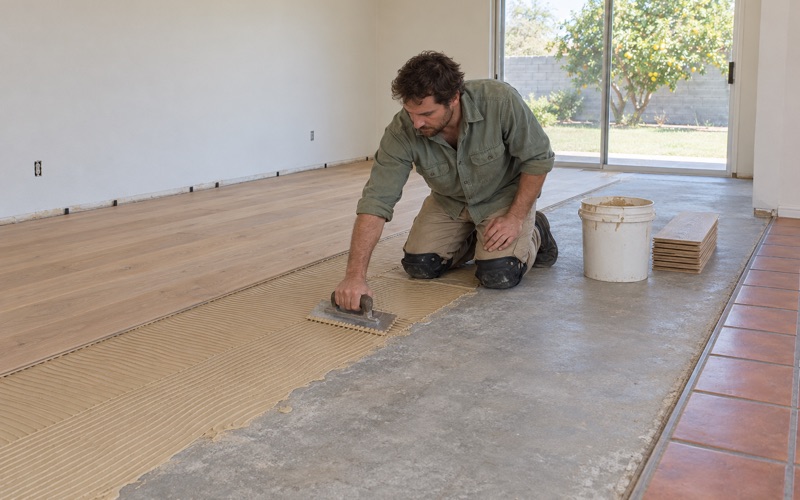
Some owners prefer to schedule full replacements, glue-down removals or subfloor repairs during turnover, when the unit is empty anyway. That timing lets us pull old flooring and adhesive, test the concrete or check the plywood subfloor, and allow full acclimation without working around anyone. An itemized record also helps at move-out, since Civil Code 1950.5 separates damage from normal wear and tear and a line-by-line estimate makes that distinction easier to document.
Turnover is also the time for work that needs a clear floor for days, such as a full sand and three coats in every room at once, or a new glue-down floor whose adhesive has to cure before traffic. We give owners a realistic calendar so the listing date and the floor schedule agree.
Floors in Costa Mesa’s 1960s and 1970s Housing
Costa Mesa incorporated on June 29, 1953, and a large share of its housing went up in the decades that followed. Census figures count 11,559 units built in the 1960s, 26.0 percent of the housing stock and the largest single decade, and 68.3 percent of all units predate 1980. Of 42,292 occupied units, 25,564, or 60.4 percent, are renter-occupied.
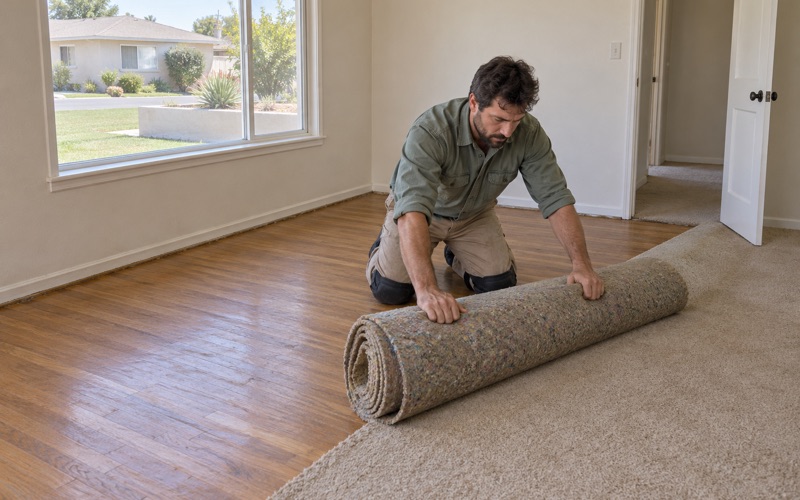
That mix shapes the work. A unit from those decades may have been re-floored more than once, so we do not assume what sits under the carpet or vinyl until it is lifted and looked at. When carpet comes up, we pull the old pad, staples and tack strip and fill the holes before any sanding starts.
Lead-Safe Sanding Before 1978
Homes built before 1978 can fall under the EPA Renovation, Repair and Painting rule when work disturbs painted surfaces, and baseboards, shoe molding and door casings are often painted. We follow lead-safe work practices on pre-1978 housing, including containment, careful trim removal and cleanup that keeps dust out of occupied rooms. With a household in place, that care matters more, not less.
Old Tile and Black Mastic
Older resilient flooring and black mastic adhesive can contain asbestos, and 9x9 asbestos floor tile is a known pattern from the period. We treat either as a possible asbestos question before anything is sanded, scraped or ground, and removal waits until the material has been tested and can be handled under SCAQMD Rule 1403 where it applies. In a building where neighbors share walls and air, guessing is not an option.
Stacked Units and the Neighbor Below
Renters here live in every building type, and 5,208 renter households are in buildings of fifty or more units. In stacked units we choose acoustic underlayment with the neighbor below in mind, and we read the association’s or owner’s rules on work hours and materials before the first board comes up.
Planning Floor Work in Costa Mesa
Measure Before Ordering
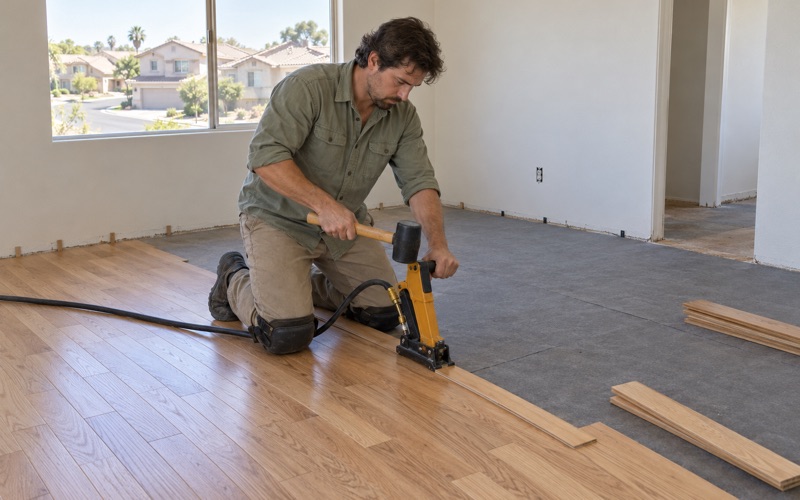
Every job begins with a wood moisture meter reading on the flooring and, over concrete, an ASTM F2170 in-situ relative humidity test or a calcium chloride test, with the numbers written into the estimate. Cupping, crowning and buckling often trace back to moisture content that was never measured. We follow NWFA installation guidelines on acclimation and expansion gaps whether the floor is glued, floated or nailed.
Choosing Floors That Hold Up in a Rental
Durability decides most rental floor choices. Species with a higher Janka hardness rating, such as white oak, hickory or maple, resist dents from furniture and pets better than softer woods, and a lower sheen level hides scratches between tenancies. On engineered flooring we look at wear layer thickness first, since it sets how many times the floor can be sanded before it has to be replaced.
Engineered and other composite wood products we install carry labeling for the formaldehyde limits in 17 CCR 93120.2 and TSCA Title VI, which matters in a small unit with the windows closed. We would rather an owner spend once on a floor that lasts several tenancies than twice on one that does not.
Repairs That Blend In
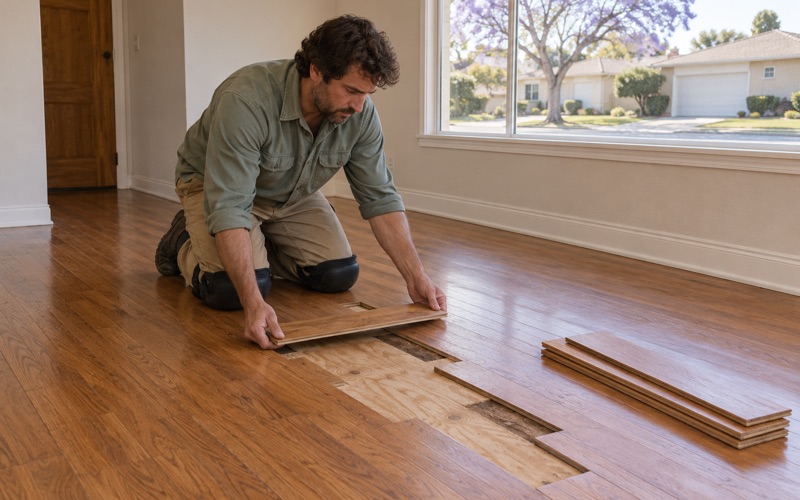
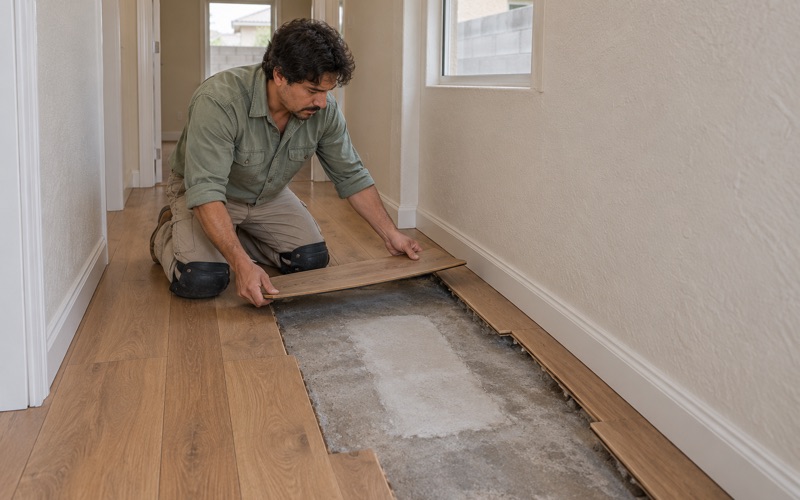
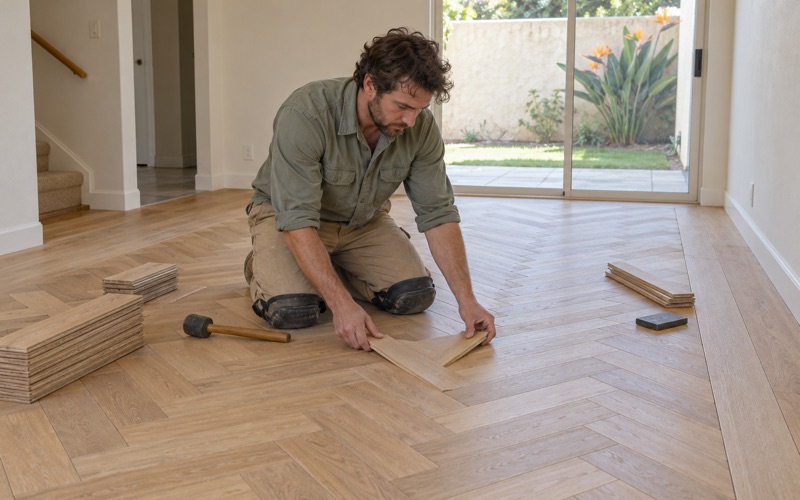
Rental floors take hard use, and full replacement is not always the right call. We match discontinued boards by species, width and finish, weave repairs into the existing field, and screen and recoat a sound floor rather than sanding it to bare wood. Pet urine stains, peeling polyurethane and water-damaged boards each call for a different answer.
Water Damage and Plumbing Repairs
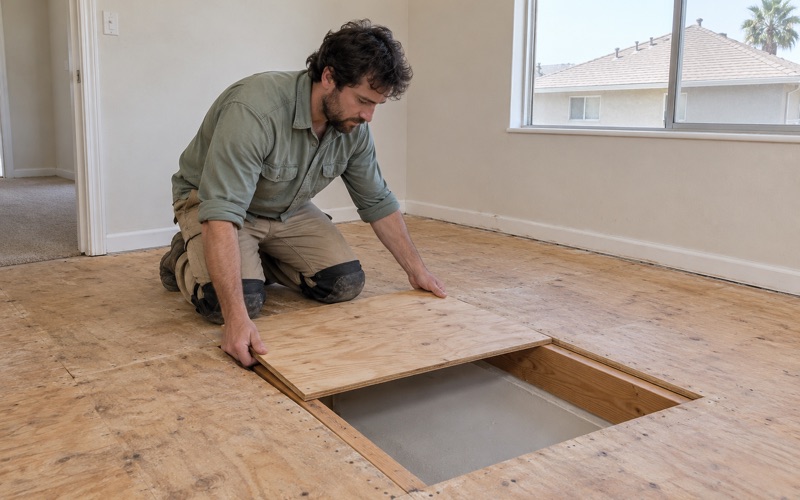
When a floor is wet, we trace the water to its source before replacing anything and document it with photos and readings an insurance adjuster can use. If a slab leak or repipe is part of the repair, we plan the plumber’s access hole with them before any boards are cut, then dry the area and patch the wood floor back in around it.
Before the Estimate Visit
For a rental, it helps to know ahead of the visit whether the unit will be occupied during the work and whether the floor is part of a larger project with its own permit application. We price stairs per tread and riser rather than by the square foot, and leave tenant-protection filings with the owner and the city, where they belong.
Much floor work on an occupied Costa Mesa rental can be sequenced so the household keeps using the home, provided the scope is written honestly and the rooms are taken in order. That is how we plan it, from the first moisture reading to the last finish coat.
- 20+ Years of Floor Work
- Written, Itemized Estimates
- Moisture Readings Recorded