Westminster Wood Flooring brings more than 20 years of work to wood flooring in Commerce, and a good share of it happens inside houses that are being put right after years of patching. Some are coming back from a city notice, some from a sale, and some from an owner who simply decided it was time. In every case the floor is one piece of a larger repair, and we price it that way.
We start underneath. The subfloor gets checked before we quote a finish floor, and the moisture content of the wood and any concrete is measured and written down before a single box is ordered. That order matters in a house where earlier repairs were done without much care, because a soft spot found after the new boards are down becomes a callback nobody wanted.
This page covers how the city finds housing problems, what its rehabilitation programs were built to do, and where floor work fits in a house being brought back to code. It is written for owners and landlords sorting out the order of a repair, not as legal advice about any violation.
How Commerce Code Enforcement Finds Housing Problems
Windshield Surveys and Complaints
The City of Commerce’s 2014-2021 Housing Element describes a code enforcement program whose stated objective is to bring substandard units into compliance with city codes. Potential violations are identified in two ways: exterior windshield surveys and complaints reported to the city. Officers work alongside Housing Division and Planning Division staff, and with property owners, to identify units in need of housing assistance.
A windshield survey sees what the street sees: roofs, siding, yards and additions. It does not see the inside of a house, which is why interior problems like a sagging subfloor or a water-stained hallway tend to surface later, when an owner starts repairs or a buyer walks through. The city’s Code Enforcement Division describes its job as keeping residential and industrial areas consistent with community standards and the Commerce Municipal Code.
Garage Conversions and Illegal Units
The same program singles out one recurring problem. To address what the Housing Element calls ‘the continuing problem of illegal units and garage conversions,’ code enforcement officers survey the city to identify such units, notify the owner that the property is in violation of city law, and enforce the actions needed to bring it into compliance.
We want to be plain about where flooring sits in that process. New boards in a converted garage do not change its legal status, and no floor job resolves a violation; what a conversion needs is a question for the owner and the city’s Building and Safety Division. What we can do is the floor work that follows once the owner and the city have settled what the space is going to be.
Why the Age of the Housing Matters
The housing stock here is old in a particular way. Census estimates put 52.2 percent of the city’s units in the 1940-1959 window, and none is estimated to have been built after 2009. The Housing Element treats units built before 1969 as the ones of general concern, which describes a large share of the houses we are likely to walk into.
Looking for wood-flooring closer to South El Monte? See South El Monte Wood-Flooring.
The Rehabilitation Programs Code Enforcement Points To
The Housing Element does not stop at finding problems. When appropriate, officers give property owners notice of rehabilitation loans or grants they may be eligible for to help correct code violations, and eligible residents were typically referred to four programs.
The Substantial Housing Rehabilitation Loan
The largest was a deferred loan of up to $100,000 for rehabilitating owner-occupied single-family homes, established by the former Commerce Community Development Commission in 2004. The repairs it covered were designed to remedy health and safety code violations, building code violations and general repairs. Floors were not singled out in that description, but the stated scope reached past violations into general repair.
The Environmental Rehabilitation Program and Ayers
The Environmental Housing Rehabilitation Grant was created because land uses in Commerce are predominantly industrial and many homes sit close to freeways and rail lines. According to the Housing Element, it was meant to address ‘the negative air quality and noise impacts created by the operation of rail road yards, freeways, and heavy industrial uses,’ and it was open to low- and moderate-income owner-occupants in the Ayers Residential Neighborhood. It was structured to provide up to $30,000 for improvements or repairs.
The Smaller Grants
Two smaller programs sat alongside those. The Neighborhood Fix-Up Grant reimbursed up to $1,000 for materials used on exterior upgrades visible from the street, and the CDBG Home Preservation Grant, funded through the Los Angeles Community Development Commission’s federal block grant, provided up to $20,000 to qualified applicants, with about $60,000 a year meant to help roughly three households.
What Happened to the Funding
The Commission that created the loan and the Ayers grant previously functioned as the city’s redevelopment agency. The Housing Element records that its elimination during the 2008-2014 planning period cost those programs their permanent funding source, and the Fix-Up Grant lost its permanent source as well. We have not confirmed the current status of any of them, so an owner should ask the city directly rather than plan a floor around money that may not exist.
The practical lesson for a floor job is to keep the two questions separate. Decide what the house needs and what it will cost on its own terms, then ask the city whether any program could help, instead of waiting on an answer before anyone has measured the rooms.
Floor Work in a House Brought Back to Code
A house coming out of a long stretch of neglect is rarely a clean refinish. Earlier owners may have laid carpet over damaged boards, glued sheet goods over old tile, or patched a subfloor with whatever was on hand. Our job is to find out what is actually there before we quote the finished surface.
Lead, Asbestos and What Is Under the Carpet
Most of the housing in Commerce was built before 1980, so on pre-1978 houses we follow lead-safe practices under the EPA Renovation, Repair and Painting rule whenever painted trim, baseboards or shoe molding come off. Old floor tile, including 9x9 tile, and black mastic are treated as a possible asbestos question before anything is sanded or scraped. If an asbestos survey is needed, it happens first and the flooring schedule follows it.
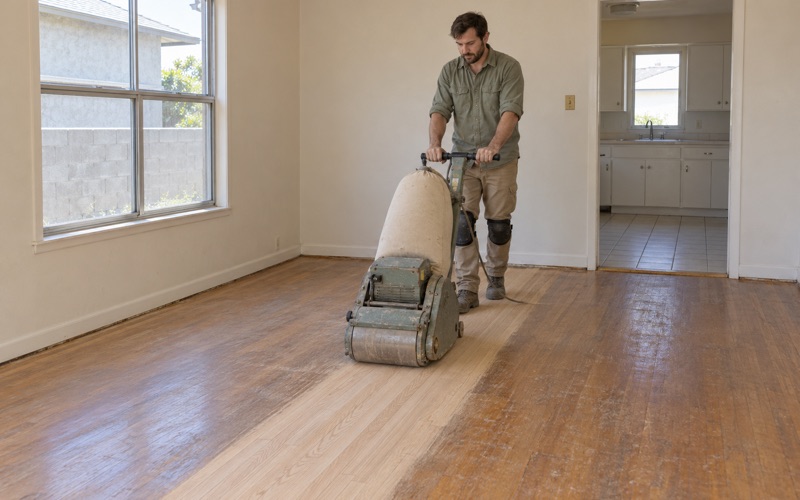
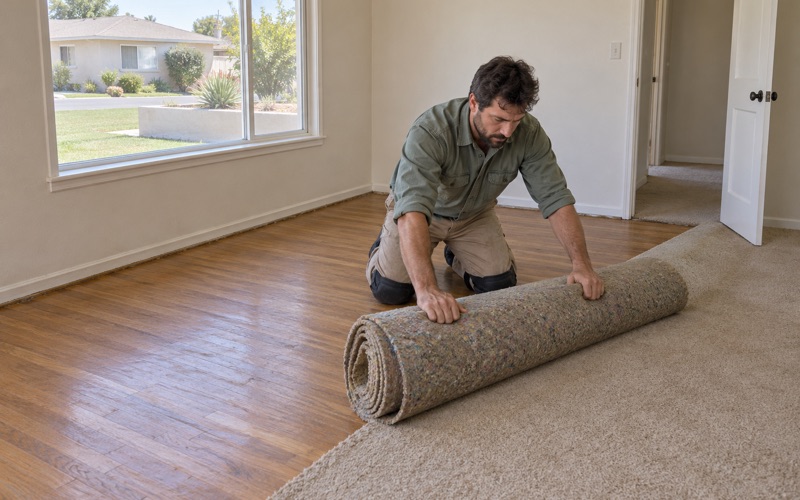
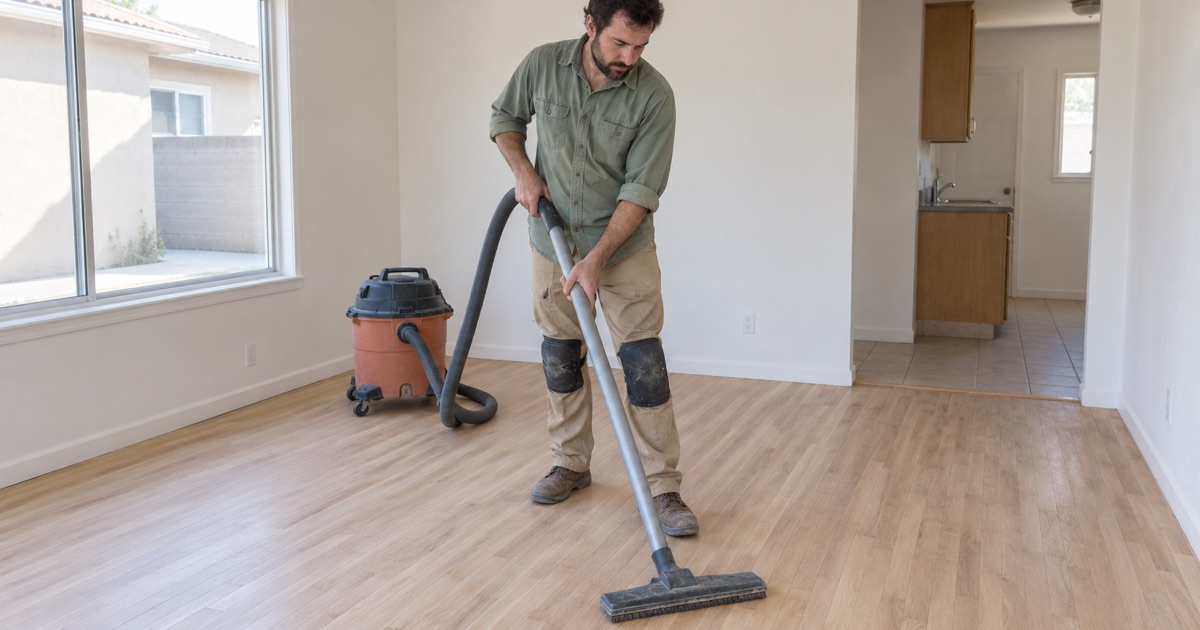
Where carpet comes up, we pull the pad, staples and carpet tack strip and fill the holes before any sanding starts. Whatever wood turns up, whether red oak, white oak or something else, refinishes cleaner when the fasteners are gone and the drum sander and edger are not catching on them. We do not assume what a Commerce house was built with; we look.
Subfloors, Water and Moisture
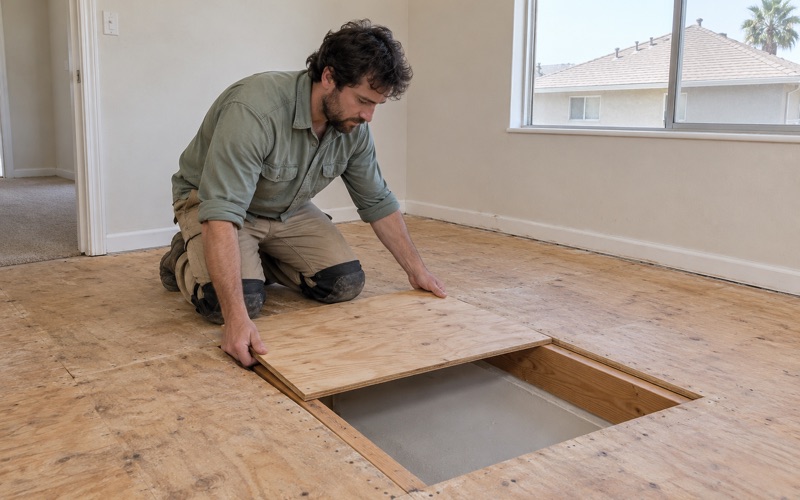
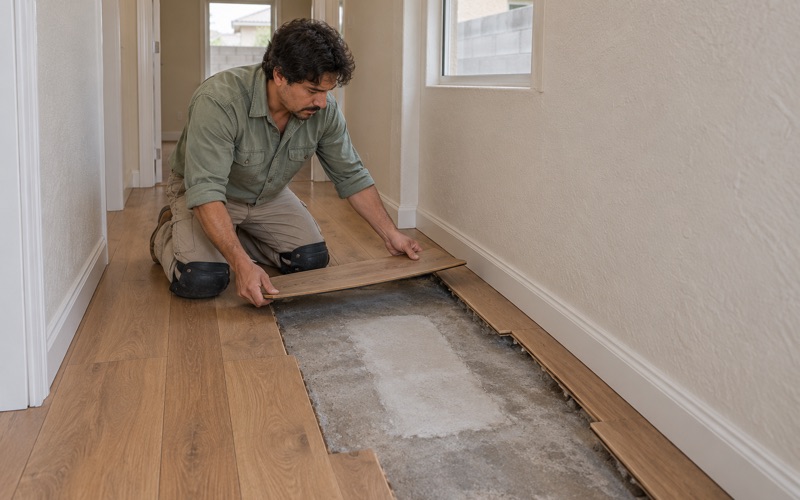
Houses that sat in disrepair often carry old water damage from a leaking supply line, a failed toilet seal or a roof leak that ran down an interior wall. We trace water-damaged floors back to the source and document them with photos and meter readings an insurance adjuster can use. Swollen plywood subfloor sheathing and soft spots over a floor joist get found and repaired before a new finish floor is priced.
Moisture is measured in the wood with a wood moisture meter, and where a room sits on concrete we test it with an ASTM F2170 in-situ relative humidity test or a calcium chloride moisture test, depending on the job. The readings go in writing. Where old glued-down flooring is coming off concrete, we take up the adhesive and test again before anything new goes down.
Converted Spaces Once the City Has Settled Them
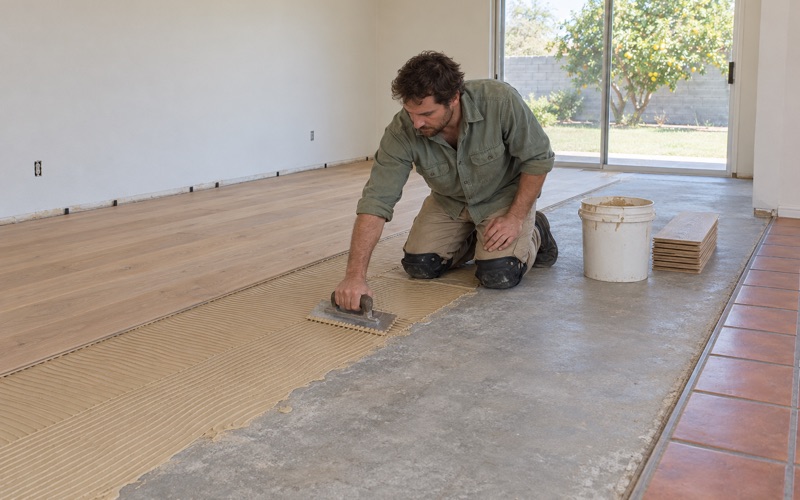
If the owner and the city have settled a converted garage or added room as permitted living space, the floor in it becomes a real design question. Concrete poured for a garage was not placed with a finish floor in mind, so we read its moisture, choose a vapor retarder, and pick between a floating or glue-down engineered floor based on those readings rather than the showroom sample.
Planning Floor Work in Commerce
Getting the Order Right
When a floor is part of a broader repair, the sequence matters more than the species. Plumbing, electrical and any structural work the city is reviewing should be settled before we sand or install, and where a slab-leak or repipe repair is planned, we map the plumber’s access hole before any boards are cut so the patch stays small and the dried-out section can be closed cleanly. The City of Commerce Building and Safety Division handles plan check, inspections and building permits, and questions about what a given job needs belong with that office.
Estimates Other People Can Read
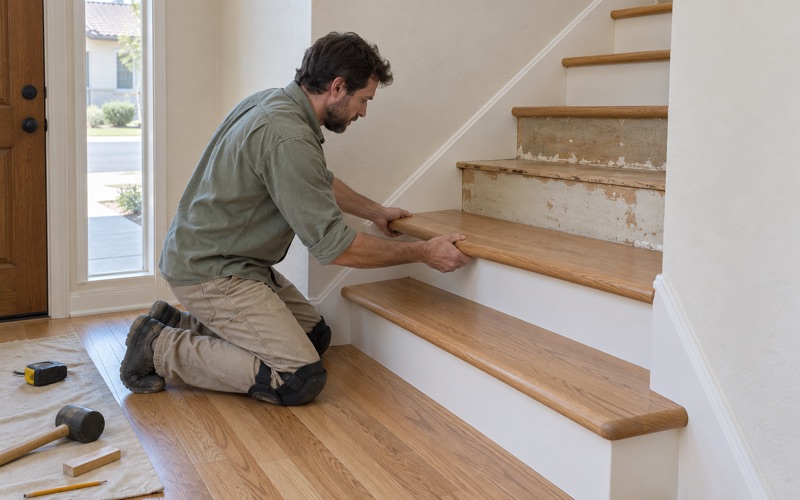
Owners bringing a house back often need paperwork for someone else: a lender, a buyer, an adjuster, or a program officer if a city program turns out to be open. Our estimates are written and itemized, with stairs priced per tread and riser instead of hidden inside a square-foot figure. That keeps the floor’s cost clear and separate from everything else the house needs.
Choosing a Floor That Has to Last
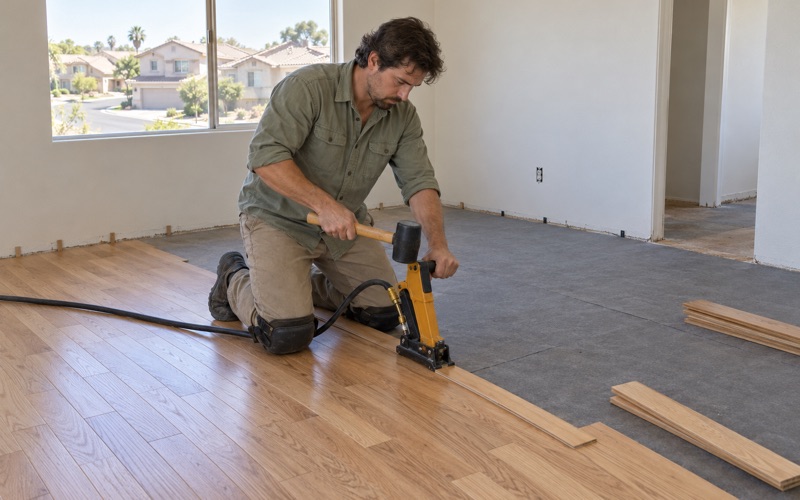
A rehabilitated house is usually expected to go a long time before anyone touches it again. For that we lean toward species with a higher Janka hardness rating, such as white oak or hickory, and toward engineered boards with a wear layer thick enough to take a future screen and recoat or a full resand. We follow NWFA installation guidelines for acclimation and expansion gaps, because a floor that cups or buckles two summers later undoes the point of the repair.
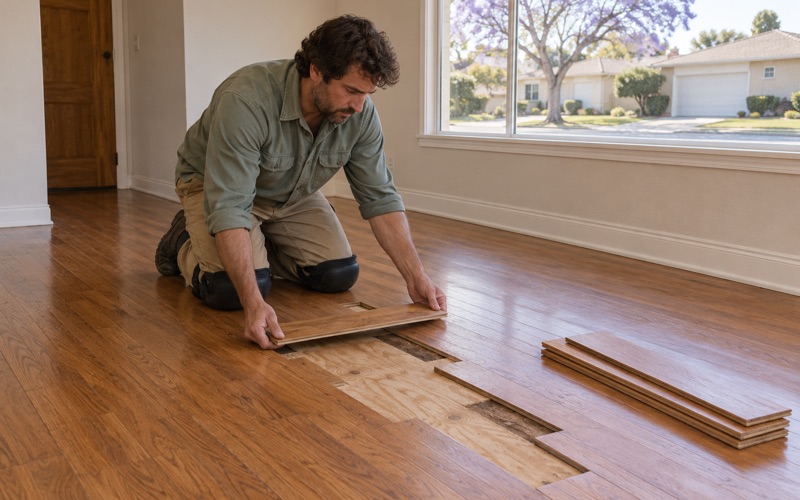
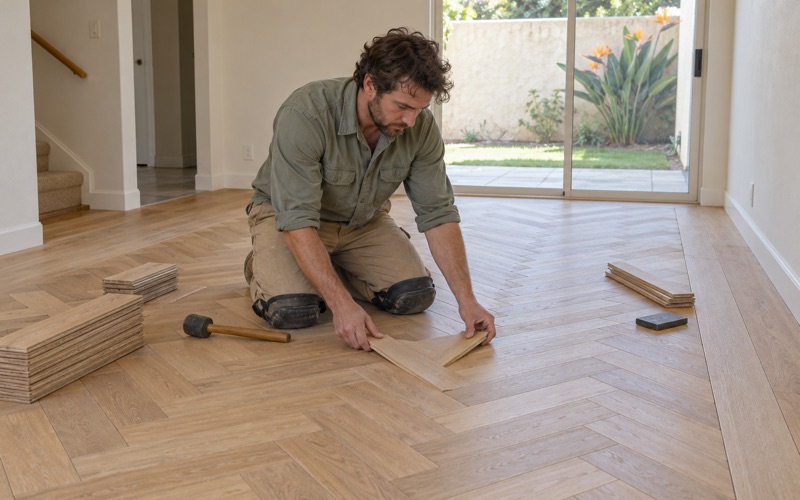
Where boards are discontinued, we match species, width and finish before a repair so a patch does not read as a patch. That is often the difference between replacing a whole room and weaving in a few rows where the old damage was.
Living in the House During the Work
Many owners stay in the house while the floors are done, and 1,581 of the city’s owner households live in detached houses, the kind of place where a family moves room to room around the crew. We contain dust and hand over a written cure schedule, so everyone knows when each room can be walked on and when furniture can go back. Finishes come from products legal to apply in the South Coast air basin under the SCAQMD Rule 1113 limit of 275 g/L for wood coatings, whether that means a waterborne polyurethane, an oil-modified polyurethane or a hardwax oil.
If a house here is in the middle of that kind of repair, we are glad to walk it, take readings and write down what we find before anyone commits to a floor. The estimate that comes out of that visit is meant to be read by whoever else is involved in getting the house right.
- 20+ Years of Floor Work
- Written, Itemized Estimates
- Moisture Readings Recorded