Westminster Wood Flooring brings more than 20 years of hands-on work to wood flooring in Buena Park, and a large share of that work happens inside apartment buildings rather than single houses. A turnover floor has to be sanded, finished and cured before the next lease begins, so the calendar matters as much as the species or the stain. We plan each apartment job backward from the move-in date.
Before anything is priced, we check the subfloor for soft spots and water-swollen sheathing and take moisture readings in the wood and in any concrete underneath, writing every number down. The estimate that follows is itemized line by line, which gives an owner something to file, to compare against a security deposit claim, or to hand to an adjuster if water was involved.
Rental owners care about three things on a floor job: how long the unit sits empty, what the finished floor will stand up to, and whether the paperwork holds up later. Those are the questions we answer on the first visit, before a single board is sanded.
How Buena Park Inspects Rental Housing
Buena Park’s Code Enforcement Division runs proactive property inspections through the city’s Neighborhood Improvement Task Force, alongside complaint response and abatement work. The city’s 2021-2029 Housing Element sets a goal of assisting 100 households a year, 800 across the planning cycle, through its weatherization, rental housing inspection and senior code enforcement relief programs. Rental inspection is one piece of a broader effort to keep older housing stock in repair.
Where the Inspections Happen
The rental housing chapter of the city code, Chapter 15.110, is written around target areas. Its stated purpose is compliance with the code’s substandard-building and property-maintenance provisions in specific areas designated by the Neighborhood Improvement Task Force and approved by the city council. If an owner or tenant refuses inspectors access, the chapter lets the city pursue any available remedy, including an inspection warrant.
Before 2023, according to the Apartment Association of Orange County, the program was driven by violations and resident complaints, focused on eight neighborhoods with a high concentration of incidents, and rotated through them every four to five years. That association was rallying its members ahead of a council vote on an expansion, so its summary is an advocacy account rather than a city document.
Which Rentals the Program Reaches
On April 25, 2023, the city council directed staff to build a phased inspection program running on three-year cycles and aimed at multi-unit rentals in specific neighborhoods, as Voice of OC reported the next day. Single-family homes, duplexes and triplexes were left out of that direction. We have not read the final ordinance text, so we treat the council’s direction as the program’s shape rather than its fine print.
In Buena Park that direction lands on a large group of tenants. Of the city’s 10,944 renter households, 5,475, or 50.0 percent, live in buildings of five or more units. The council also asked for a one-year education effort aimed at landlords and tenants alike.
What an inspector examines inside a unit is set by the city, and we do not speak for it. Our part is the floor itself: a surface that is sound, flat and finished before a tenant moves in, and paperwork that shows what was done.
Looking for wood-flooring closer to Costa Mesa? See Wood-Flooring Services in Costa Mesa.
Floors in Buena Park’s Apartment Buildings
Buena Park’s housing stock is mostly older. Of 24,877 housing units, 9,097, or 36.6 percent, were built in the 1950s, the city’s largest single decade of construction. A floor in a building that age has usually been through several rounds of upgrades, and what sits under the current surface is rarely known until it comes up.
Carpet, Tile and What Lies Beneath
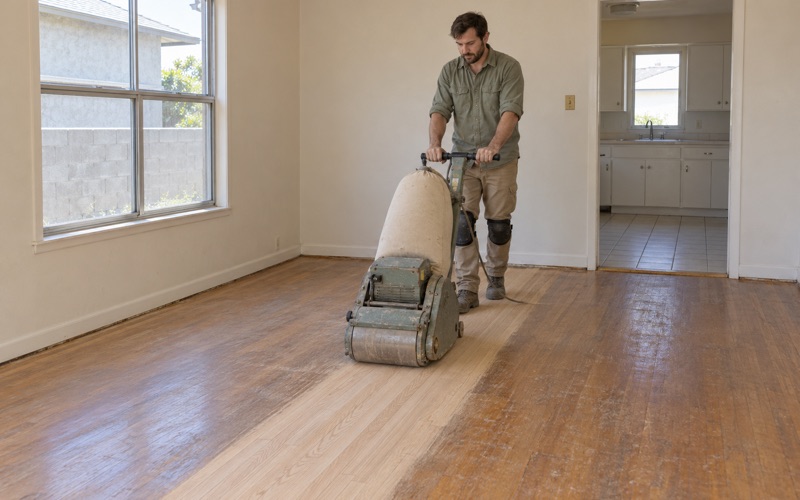
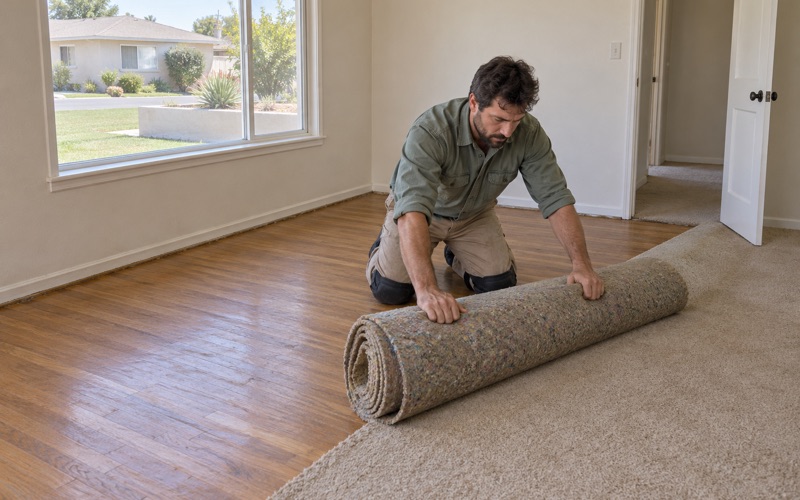
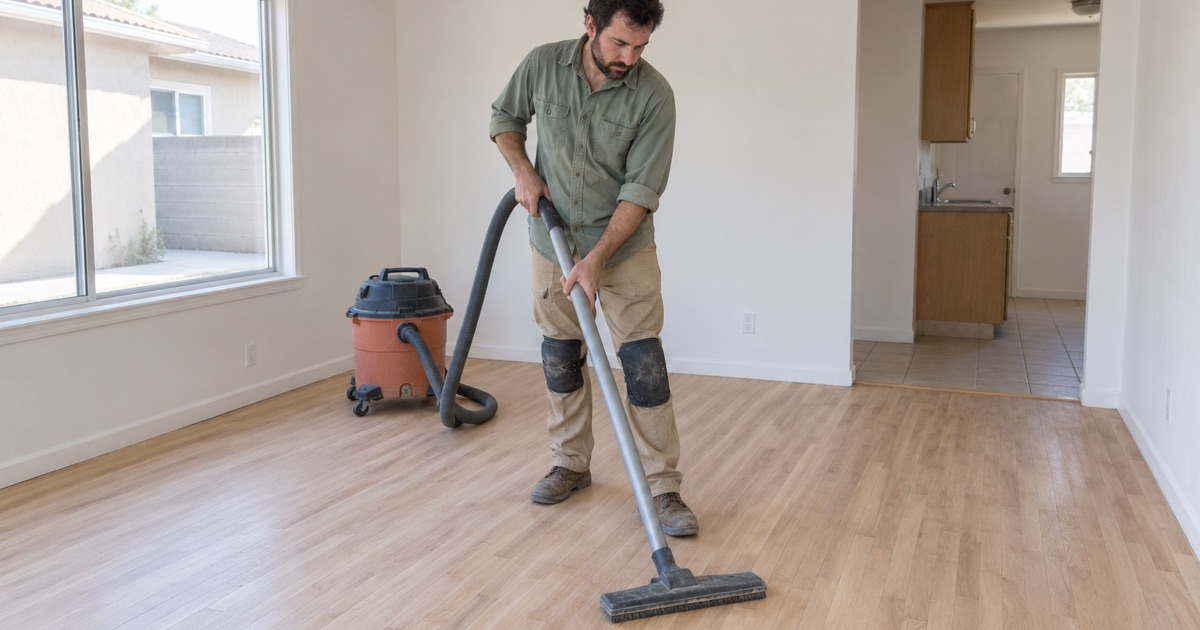
When carpet comes up in an older unit, we lift the pad, pull every staple and tack strip, and fill the holes before a sander touches the wood. That prep is what lets hardwood found under carpet refinish without a ring of nail holes around the room’s edge. If the boards turn out to be too thin or too damaged to sand again, we say so before quoting a refinish.
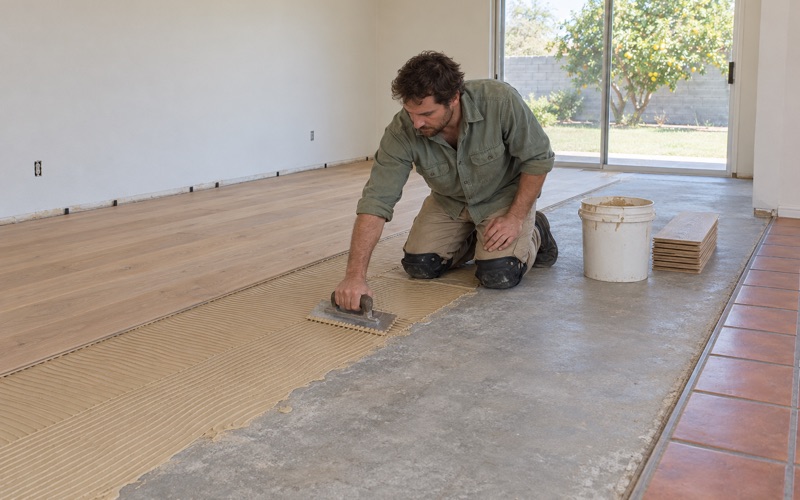
Old floor tile and black mastic get different treatment. In a building of this era, 9x9 tile and the adhesive under it are treated as a possible asbestos question, and nothing is sanded, scraped or ground until an asbestos survey answers it. Where glued-down flooring comes off concrete, we remove the old adhesive and test the slab with a calcium chloride or ASTM F2170 relative humidity test before anything new is laid.
Lead-Safe Work in Pre-1978 Buildings
Of those same units, 76.2 percent predate 1980, so a large share of Buena Park buildings fall on the older side of the 1978 line the EPA Renovation, Repair and Painting rule draws for lead-based paint. We follow lead-safe work practices in any pre-1978 building, which matters around the baseboards, door casings and shoe molding that get pulled or sanded during a floor job. Dust containment runs through the whole project, not only the sanding days.
Upstairs Units and the Neighbor Below
In a building of five or more units, many floors sit over someone else’s ceiling. We choose acoustic underlayment with the downstairs neighbor in mind, and on a condominium or association property we read the association’s alteration rules and work-hour limits before any floor comes up. A floating engineered floor over a good underlayment is often the practical choice upstairs, while a glue-down installation may suit a ground-floor unit once the moisture readings allow it.
Planning Floor Work Between Tenants
A vacant unit is the best window an owner gets. Nobody is walking on fresh finish, furniture is out, and the dust containment only has to protect the hallway and the units next door. We schedule sanding, coats and cure time to fit inside that window and give the owner a written cure schedule showing when the unit can take foot traffic and when it can take furniture.
Timing is where most turnover floors go wrong. A finish that is walked on or loaded with furniture too early shows it for years, so we would rather tell an owner that a unit needs an extra day than hand back a floor that marks the first week.
Some floor work has to happen with a tenant still living in the unit. Buena Park’s Housing Eviction Legal Protection ordinance, Chapter 8.60, gives renters protections the city describes as greater than the California Tenant Protection Act, so we leave notice and access arrangements to the owner and then work room by room inside the schedule they set.
Refinish, Recoat or Replace
Not every turnover needs a full sanding. A floor with a sound finish and light wear can often take a screen and recoat, which is faster and keeps more of the wear layer for later. Cupping, deep pet urine stains or peeling polyurethane push the job toward sanding through a full grit sequence or toward board replacement in the damaged area.
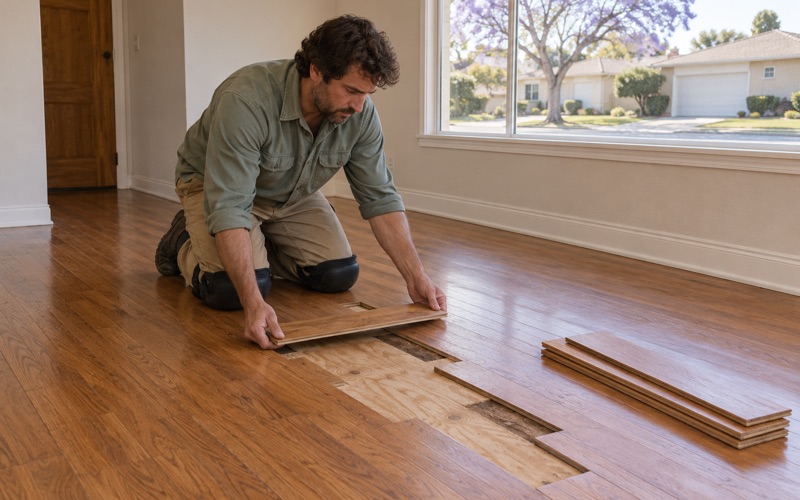
When boards are replaced, we match the discontinued material by species, width and finish so the repair does not read as a patch to the next tenant. For finishes we use products legal to apply in the South Coast air basin under the 275 g/L wood-coating limit in SCAQMD Rule 1113, and a waterborne polyurethane usually suits a tight turnover best because of its lower odor and quicker recoat times.
Documenting the Floor’s Condition
Owners handling a move-out often need to separate normal wear and tear from damage beyond it under Civil Code 1950.5, which governs security deposits. We photograph the floor before work begins and itemize the estimate by room and by task, which gives the owner a record rather than a single lump figure. We do not decide what a deposit can cover; the record simply makes that conversation easier.
Planning a Floor Project in Buena Park
Not every Buena Park job is a rental. Owner households here live overwhelmingly in detached houses, 11,688 of 13,378, and those houses get the same moisture readings, subfloor check and pre-1978 lead-safe practices as an apartment. The difference is usually the household living through the work, which is where the written cure schedule earns its place.
Species, Stairs and Transitions
Species choice in a rental is mostly about the Janka hardness rating and how the floor will look after years of tenant traffic. Red oak and white oak hide wear well and refinish predictably, while hickory is harder still; softer species and very dark stains show scratches sooner. Whatever the species, new flooring is delivered and acclimated in the unit, and we check its moisture content against the subfloor before installation starts, following NWFA installation guidelines.
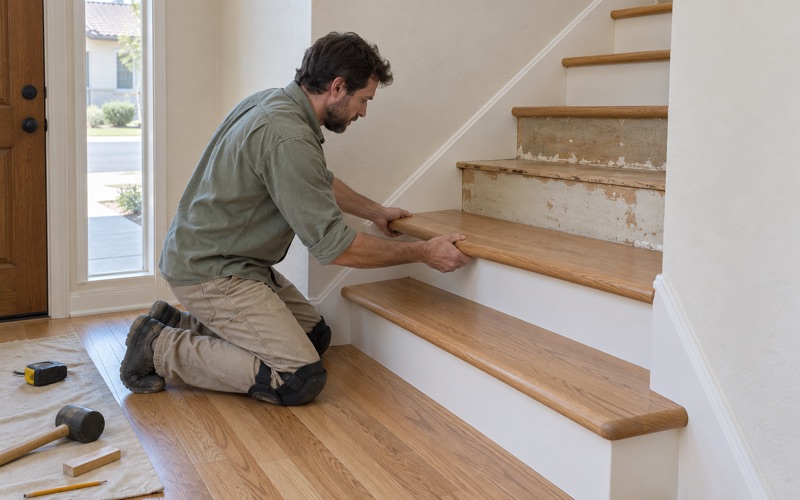
Stairs in a two-story unit or townhouse get priced separately, per tread and riser, because a stair tread, its riser and the stair nosing each take hand work that a square-foot rate hides. Reducer strips and T-molding at doorways are listed too, since a new floor rarely meets the old one at the same height.
Water Damage and Slab Leaks
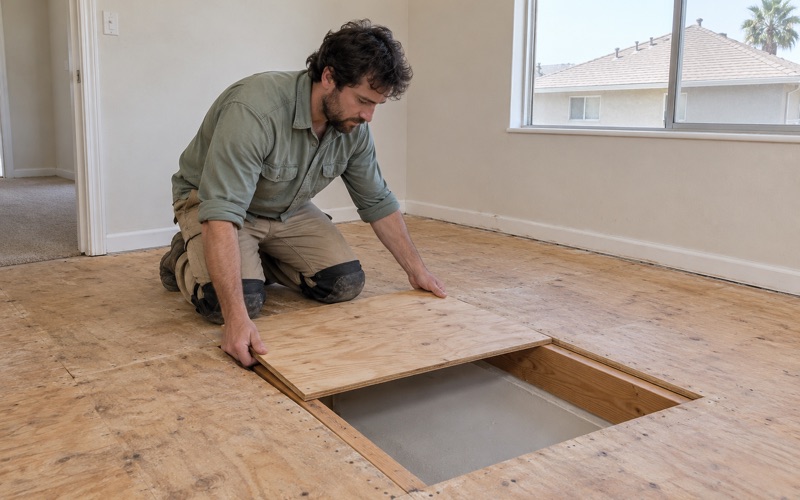
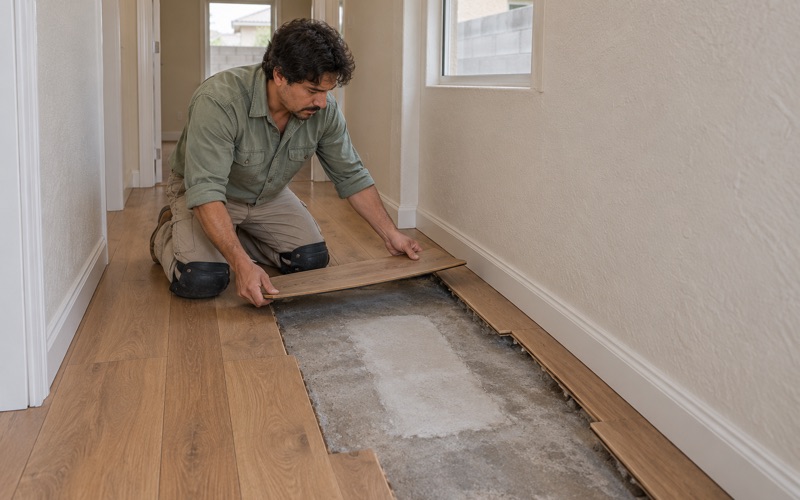
When a floor is wet, we trace the water to its source before replacing anything, and we document the damage with photos and moisture readings an insurance adjuster can use. If a slab leak or repipe is part of the repair, we plan the plumber’s access hole before boards are cut, then open, dry and patch the wood floor around it. Cupping and buckling that show up weeks after a leak usually mean the drying was cut short.
City Help for Older Houses
Owners with limited income may want to ask the city about its housing programs before a larger repair. The Housing Element lists a Home Improvement Program offering deferred loans of up to $100,000 at 1 percent simple interest to households earning up to 80 percent of area median income, and a Senior Code Enforcement Relief Program for low-income owners 55 and older referred by Code Enforcement. Eligibility and funding are the city’s call, not ours.
Whether the unit is between leases or a family is staying put, the first visit is the same: moisture readings, a subfloor check and a look at what is under the current surface. From there we write an itemized estimate that shows the work, the order it happens in and the days each room will be out of use.
- 20+ Years of Floor Work
- Written, Itemized Estimates
- Moisture Readings Recorded